



Why One RFID Tag Cannot Solve Every Industrial Tracking Challenge
RFID technology has transformed the way businesses track equipment, manage inventory, monitor assets, and improve operational efficiency. From manufacturing plants and warehouses to construction sites and logistics facilities, RFID tags help organisations identify and locate valuable items with greater speed and accuracy.
However, choosing an RFID solution is not as simple as selecting one tag and using it across every application.
Industrial environments present different challenges. Some assets are exposed to extreme temperatures, moisture, chemicals, or heavy mechanical impact. Others are made from metal, stored in confined spaces, or moved through areas where reliable long-range identification is essential.
A standard RFID tag may perform well in one application but deliver inconsistent results in another. This is why selecting the right RFID tag requires a clear understanding of the tracking environment, the materials being tagged, and the operational requirements.
Different Industrial Environments Require Different RFID Tags
Industrial facilities rarely provide a uniform operating environment. A warehouse, an outdoor construction site, and a manufacturing production line all have different conditions that can affect RFID performance.
For example, inventory stored in a dry warehouse may only require basic identification and tracking capabilities. Equipment used outdoors, however, may need tags that withstand rain, dust, temperature fluctuations, and physical impact.
In manufacturing environments, RFID tags may be exposed to oils, cleaning agents, vibration, and repeated handling. Tags used in these conditions must be selected according to their resistance and durability.
Common environmental factors include:
Temperature: High-temperature production processes can damage ordinary RFID tags.
Moisture: Water exposure and humidity can affect tag durability and long-term reliability.
Dust and chemicals: Industrial contaminants may damage tag materials or protective housings.
Physical impact: Equipment and reusable containers may experience repeated knocks, abrasion, and handling.
Outdoor exposure: UV radiation, rain, and changing weather conditions can shorten tag service life.
The right RFID tag should match the actual conditions in which an asset operates, rather than simply meeting basic identification requirements.
Metal Surfaces Can Affect RFID Tag Performance
One of the most common challenges in industrial RFID applications is tracking metal assets.
Metal surfaces can interfere with radio frequency signals, affecting the communication between RFID tags and readers. A conventional RFID tag designed for cardboard, plastic, or other non-metallic materials may experience reduced read range or unreliable performance when attached directly to metal.
This is particularly important in industries that track:
Industrial machinery and production equipment
Metal containers and storage racks
Tools and maintenance equipment
Vehicles and automotive components
Steel pipes and industrial components
On-metal RFID tags are specifically designed to operate on or near metallic surfaces. Their construction helps reduce the impact of metal interference and supports more reliable identification.
For organisations managing large numbers of metal assets, selecting tags designed for these surfaces can make a significant difference to tracking performance.
Different Assets Have Different Tagging Requirements
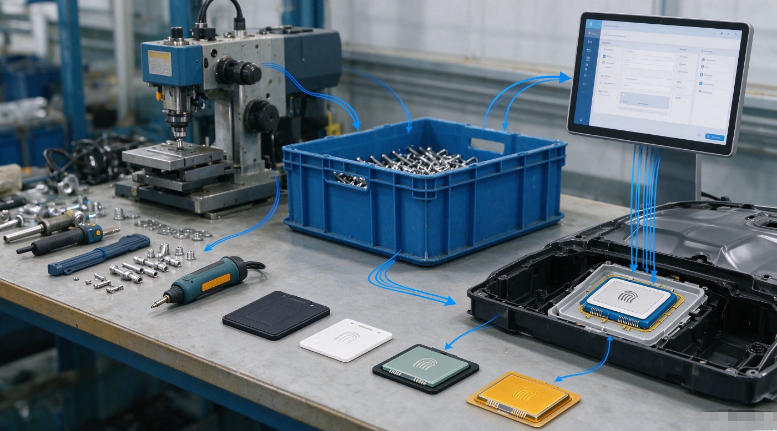
Not every industrial asset has the same shape, size, material, or tracking requirements. A tag suitable for a large storage container may not be practical for a small handheld tool.
The physical design of an RFID tag is therefore an important consideration.
For example, compact RFID tags may be more suitable for small tools and components where installation space is limited. Larger industrial tags may provide a more practical solution for equipment, reusable containers, and fixed assets.
Common RFID tag formats include:
Hard tags: Durable tags designed for industrial assets that require repeated identification.
On-metal tags: Specialised tags for equipment and objects with metallic surfaces.
Flexible RFID tags: Suitable for applications requiring a thinner or more adaptable tag structure.
Embedded RFID tags: Integrated into products or equipment during manufacturing.
High-temperature RFID tags: Designed for applications involving elevated operating temperatures.
Choosing the appropriate form factor helps ensure that tags can be installed securely without interfering with normal equipment operation.
Read Range and Frequency Must Match the Application
RFID tags operate at different frequencies, and each frequency offers different performance characteristics.
The three main RFID frequency categories are LF (Low Frequency), HF (High Frequency), and UHF (Ultra-High Frequency).
| RFID Frequency | Typical Applications | Key Characteristics |
| LF (125–134.2 kHz) | Animal identification, industrial access control | Short read range, suitable for certain challenging environments |
| HF (13.56 MHz) | Access cards, product identification, smart labels | Short-range communication, widely used for close-range identification |
| UHF (860–960 MHz) | Warehouse inventory, logistics, equipment tracking | Longer read range and efficient bulk reading |
UHF RFID is commonly used in industrial tracking because it supports relatively long read distances and can identify multiple tagged items quickly.
However, a longer read range is not always better.
For example, a maintenance technician identifying one specific tool may need controlled, close-range reading to avoid detecting nearby assets. In contrast, a warehouse operator scanning multiple pallets may benefit from a longer read range and bulk-reading capabilities.
The appropriate frequency and antenna configuration should therefore be determined by the tracking workflow, reader compatibility, and surrounding environment.
Durability Is Essential for Long-Term Industrial Tracking
An RFID tag is only useful if it continues to function throughout its intended service life.
In industrial operations, tags may remain attached to assets for years. Replacing damaged tags can create additional labour costs, disrupt tracking records, and increase maintenance requirements.
Durability should be evaluated according to the specific application.
Important considerations include:
IP rating: Indicates protection against dust and water ingress under defined testing conditions.
Operating temperature: Determines the temperature range in which the tag is designed to function.
Material resistance: Helps establish whether the tag can withstand oils, chemicals, and other substances.
Mechanical strength: Determines its ability to withstand impact, pressure, and abrasion.
Mounting method: Adhesive, screws, rivets, or other installation methods may be suitable for different assets.
For example, a reusable plastic container may require a different tag construction from machinery operating in a hot industrial processing area.
Selecting a durable RFID tag based on actual operating conditions can help reduce replacement frequency and support more consistent asset management.
Different Tracking Goals Require Different RFID Solutions
Industrial RFID systems are used for several purposes, and each application has its own priorities.
A business tracking warehouse inventory may focus on reading large quantities of products quickly. A manufacturer monitoring production equipment may prioritise accurate identification and long-term tag durability.
Here are several examples:
Equipment and Tool Tracking
Industrial equipment and tools often move between departments, maintenance areas, and production facilities. RFID tags help assign unique identities to individual assets, making it easier to maintain inventory records, monitor usage, and support maintenance activities.
Warehouse and Inventory Management
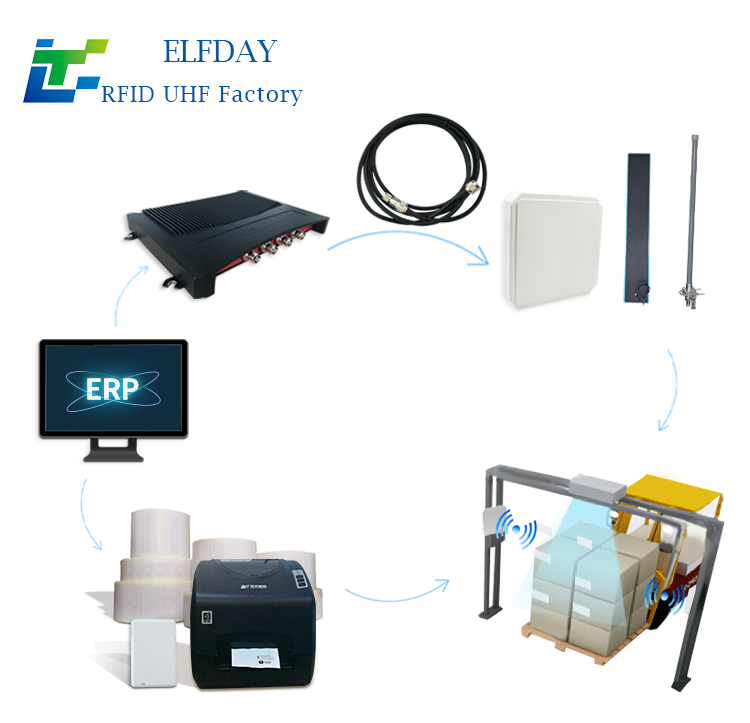
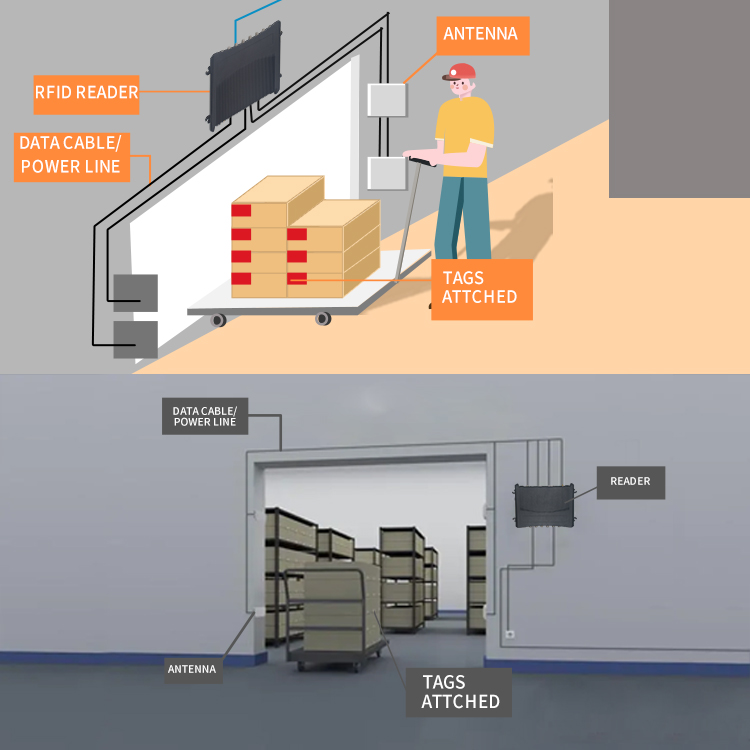
Warehouses handle large volumes of goods, pallets, and containers. UHF RFID tags can support faster inventory checks, goods receiving, and dispatch operations by allowing multiple tagged items to be identified within a suitable reading zone.
Manufacturing and Production Tracking
Manufacturing facilities may need to monitor products as they move through different production stages. RFID tags can help connect physical items with production records, inspection information, and process data.
Vehicle and Fleet Management
Vehicles and transport equipment require identification solutions that can operate under changing outdoor conditions. Tag placement, reading distance, mounting method, and environmental resistance all need to be considered.
Returnable Transport Item Tracking
Reusable containers, bins, and pallets circulate between suppliers, warehouses, and production facilities. RFID identification helps businesses monitor their movement, improve asset visibility, and reduce losses.
These examples demonstrate why a single RFID tag design is unlikely to deliver optimal performance across every industrial application.
How to Choose the Right RFID Tag for an Industrial Application
Before selecting an RFID tag, businesses should evaluate the complete tracking process rather than focusing on the tag alone.
The following questions can help narrow down the available options:
-
What asset needs to be tracked? Identify whether the target is equipment, tools, containers, vehicles, or individual components.
-
What material is the asset made from? Metal surfaces may require specialised on-metal RFID tags.
-
Where will the tag operate? Consider indoor and outdoor conditions, temperature, moisture, dust, and chemical exposure.
-
How far away must the tag be read? Determine whether close-range identification or longer-distance reading is required.
-
How will the tag be installed? Check the available mounting space and whether adhesive, screws, or embedding is appropriate.
-
What RFID system is already in use? Ensure compatibility with the reader frequency, supported protocols, and operating region.
-
How long should the tag last? Consider the expected asset life, usage frequency, and maintenance requirements.
Testing RFID tags under real operating conditions is also important. Factors such as tag orientation, reader antenna placement, nearby materials, and surrounding radio frequency interference can all influence actual reading performance.
A tag that performs well in a laboratory test may behave differently when installed on equipment inside a busy industrial facility.
Industrial tracking challenges are too diverse for one RFID tag to handle every requirement effectively. Differences in materials, environmental conditions, asset sizes, read distances, and operational workflows all influence RFID performance.
The most effective approach is to select RFID tags according to the specific application. On-metal tags, high-temperature tags, durable hard tags, and flexible RFID solutions each serve different industrial needs.
By evaluating the tracking environment and testing tag performance before deployment, businesses can build more reliable RFID tracking systems, improve asset visibility, and reduce the operational problems associated with unsuitable identification solutions.
Ultimately, successful industrial RFID tracking is not about finding one universal tag. It is about finding the right tag for each tracking challenge.