



How to Select RFID Tags for Long-Term Asset Identification
Long-term asset identification requires more than attaching an RFID tag to a piece of equipment. Businesses need tags that remain readable, securely attached, and compatible with their RFID systems throughout the asset's service life. The right tag can help organizations identify equipment, maintain accurate asset records, simplify audits, and reduce the time spent on manual inspections.
However, RFID tags vary in frequency, construction, memory, mounting method, and environmental resistance. Selecting a tag without considering its intended lifespan and operating conditions may lead to premature failure, inconsistent reads, or unnecessary replacement costs.
This guide explains how to select RFID tags for long-term asset identification, from defining asset requirements to testing tag performance and evaluating total cost of ownership.
1. Define the Asset Identification Requirements
Before comparing RFID tags, identify the assets that need to be tracked and how the identification system will be used.
Typical applications include:
-
Industrial machinery and production equipment
-
IT equipment, servers, and electronic devices
-
Tools, instruments, and maintenance equipment
-
Reusable containers, pallets, and returnable transport items
-
Fixed assets in warehouses, factories, hospitals, and commercial facilities
Consider how long each asset is expected to remain in service, how frequently it will be inspected, and whether it will move between locations.
For example, a tag attached to a stationary electrical cabinet may have different requirements from one installed on a reusable container that is handled daily. A tag on a frequently serviced machine may also need to withstand repeated cleaning, vibration, and contact with tools.
Create a basic requirements list covering asset type, expected service life, reading method, operating environment, and maintenance procedures. This provides a practical starting point for tag selection.
2. Choose the Right RFID Frequency
RFID frequency affects reading distance, tag size, reader compatibility, and how tags perform in different applications.
UHF RFID Tags
UHF RFID tags are commonly used for inventory management, warehouse operations, equipment identification, and bulk asset audits. Depending on the tag design, reader, antenna, environment, and applicable regulations, UHF systems can identify multiple tagged assets without requiring each tag to be scanned individually at close range.
UHF RFID may be suitable when an organization needs to inspect many assets efficiently or read tags from a designated scanning area.
HF and NFC Tags
High-frequency (HF) RFID tags operate at 13.56 MHz. NFC is a related technology operating at the same nominal frequency and is designed for compatible close-range interactions.
HF or NFC tags can be useful when an employee needs to tap a compatible device against an asset to retrieve identification information, maintenance instructions, or a digital record.
How to Decide
| Requirement | Technology to consider |
| Rapid audits of many assets | UHF RFID |
| Reading tags at a controlled distance | UHF RFID, subject to system design |
| Close-range identification using compatible devices | HF RFID or NFC |
| Existing RFID infrastructure | Match the tag to the system's frequency and protocol |
Do not choose a frequency based on reading distance alone. Confirm compatibility with existing readers, software, and operating procedures before purchasing tags in bulk.
3. Evaluate the Tag's Expected Service Life
For long-term asset identification, tag durability is a core selection criterion. A tag may function correctly during initial testing but fail later because its housing deteriorates, its adhesive weakens, or its attachment method cannot withstand repeated use.

Evaluate the following factors:
-
Material stability: Select materials suitable for the expected exposure to sunlight, moisture, heat, and cleaning agents.
-
Mechanical durability: Consider abrasion, impact, bending, vibration, and repeated handling.
-
Attachment reliability: Ensure the tag remains secured to the asset throughout normal operation.
-
Environmental resistance: Confirm suitability for the actual temperature range, dust, water, oils, and chemicals involved.
-
Read consistency: Test whether the tag can be identified reliably after exposure to representative operating conditions.
A tag's expected lifetime depends on its construction, installation, environment, and use. Avoid assuming that every RFID tag will last as long as the asset itself.
Ask the supplier for available durability data, environmental test results, recommended mounting conditions, and warranty terms. Where long service life is essential, validate these claims through application-specific testing.
4. Select a Tag That Matches the Asset's Surface
The material and shape of the asset can significantly affect RFID performance.
Metal Assets
Metal can detune or interfere with conventional RFID tag antennas, particularly when a tag is mounted directly on a conductive surface. For machinery, metal cabinets, tools, and industrial equipment, an appropriately designed on-metal or anti-metal RFID tag may be required.
These tags use designs intended to operate on or near metal. Their performance still depends on the specific tag construction, mounting position, reader configuration, and surrounding materials.
Plastic, Wood, and Other Non-Metallic Surfaces
Many standard RFID labels and tags can be used on non-metallic surfaces. However, the surface curvature, adhesive compatibility, moisture content, and proximity to liquids or other materials may affect performance.
Curved, Textured, or Irregular Surfaces
For cylindrical equipment, narrow tools, or assets with limited mounting space, consider the available attachment area and tag dimensions. A tag that fits poorly may be damaged or detached during normal use.
Whenever possible, test the selected tag on the actual asset rather than relying only on performance data collected under ideal laboratory conditions.
5. Choose a Secure and Maintainable Mounting Method
A durable RFID chip is not enough if the tag becomes detached from the asset. The mounting method should suit the asset's material, shape, usage, and maintenance requirements.
Common options include:
-
Industrial adhesive: Suitable for compatible surfaces when the adhesive can withstand expected temperatures, moisture, chemicals, and surface conditions.
-
Screws or mechanical fasteners: Useful when the asset design allows secure physical attachment.
-
Rivets: May be appropriate for certain equipment housings and durable identification applications.
-
Cable ties or mounting brackets: Useful for selected tools, containers, cables, and irregularly shaped assets.
-
Embedded or integrated tags: Consider these during product or equipment design when long-term identification is a critical requirement.
Surface preparation is important for adhesive mounting. Oil, dust, roughness, coatings, and low surface energy can reduce adhesion. Follow the manufacturer's installation instructions and allow any specified curing time before evaluating the bond.
Also consider whether the tag must remain accessible for inspection or replacement. Permanent attachment is not always the best option when assets are refurbished, transferred, or regularly maintained.
6. Determine the Required Memory and Identification Method
An RFID tag does not need to store an entire asset history to support long-term identification.
In many systems, the tag carries a unique identifier that links to an asset record in a management database. The database stores information such as:
-
Asset name and serial number
-
Ownership and department
-
Purchase date and warranty details
-
Location and assigned employee
-
Maintenance history and inspection records
-
Current status and disposal information
This approach can simplify data management because records can be updated without replacing the tag.
When choosing a tag, determine whether the system needs only a unique identifier or additional information stored directly on the tag. Check the available memory, supported data format, security requirements, and compatibility with the reader and software.
For long-term projects, establish a consistent identifier format and define how duplicate, damaged, or replaced tags will be handled. A reliable identification process is just as important as the physical tag.
7. Consider Read Range and Installation Conditions
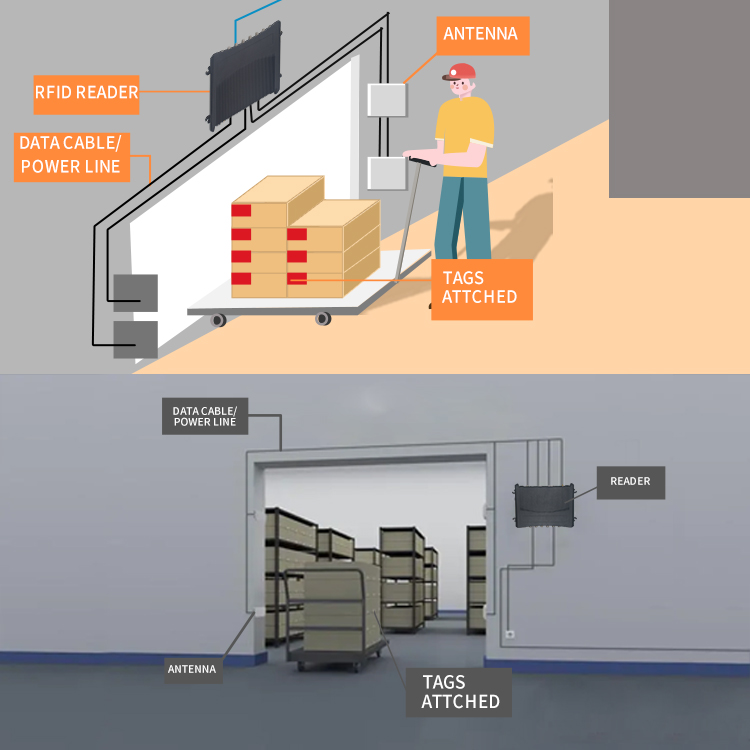
The required read range depends on how employees will identify assets. A handheld reader used during an annual audit has different requirements from a fixed reader installed at a warehouse entrance.
Before selecting a tag, consider:
-
Whether reading will be performed manually or automatically
-
The distance between the tag and the reader
-
The orientation of the tag and reader antenna
-
The number and density of assets being read together
-
The presence of metal, liquids, or other radio-frequency obstacles
-
The potential for adjacent tags to be read unintentionally
Manufacturer specifications can provide a useful starting point, but quoted read ranges should not be treated as guaranteed field performance. Actual results depend on the complete RFID system and operating environment.
Test tags at realistic distances, angles, and mounting positions. For long-term asset programs, document the approved tag and reader configuration so that future replacements can be evaluated consistently.
8. Check Compatibility With Existing RFID Infrastructure
Long-term asset identification programs may operate for many years. Replacing readers or changing software during that period can create compatibility issues if tag requirements are not documented.
Verify the following before ordering:
-
RFID frequency and applicable regional requirements
-
Air-interface protocol supported by the reader
-
Required tag memory and identifier format
-
Reader and antenna compatibility
-
Software or asset-management integration
-
Data security and access-control requirements
For UHF systems, for example, confirm that the tag supports the protocol required by the installed readers. For HF and NFC applications, verify that the tag is compatible with the intended reader or mobile device.
If an organization uses multiple sites or plans future expansion, standardizing on a tested tag specification can make procurement, maintenance, and replacement easier.
9. Evaluate Total Cost of Ownership
The lowest unit price does not always result in the lowest long-term cost.
When comparing RFID tags, consider the complete cost of deploying and maintaining them:
-
Initial tag purchase price
-
Installation labor and surface preparation
-
Reader and software requirements
-
Testing and deployment costs
-
Replacement frequency
-
Manual work caused by unreadable or missing tags
-
Downtime or delays during asset audits
A more durable tag may have a higher initial price but offer better value when replacement is difficult or costly. Conversely, a premium industrial tag may be unnecessary for an indoor asset that is rarely handled and operates in a controlled environment.
Compare options using the same service-life assumptions and operating conditions. Where possible, use pilot results to estimate replacement rates and maintenance effort rather than relying on general claims.
10. Test Before Large-Scale Deployment
A pilot project helps confirm whether the selected tag is appropriate for the real application.
A practical validation process includes:
-
Select representative assets, including difficult surfaces and operating locations.
-
Install sample tags using the proposed production method.
-
Test reading performance with the intended readers and software.
-
Expose samples to representative handling, cleaning, and environmental conditions.
-
Inspect adhesion, housing condition, and readability after testing.
-
Record failures, installation issues, and any required adjustments.
-
Finalize the tag specification and installation procedure before bulk procurement.
For assets expected to remain in service for many years, accelerated or environmental testing may help assess specific failure risks. However, accelerated test results do not automatically establish a precise service life under every field condition.
Keep records of the approved tag model, supplier, mounting method, reader configuration, and validation results. These records will support future purchasing and troubleshooting.
Long-Term RFID Asset Identification Checklist
Before selecting an RFID tag, confirm that you can answer the following questions:
-
What assets need to be identified, and how long will they remain in service?
-
Are the assets made of metal, plastic, wood, or mixed materials?
-
Will the tags encounter heat, moisture, chemicals, abrasion, or vibration?
-
Should assets be read individually or in groups?
-
Which RFID frequency and protocol does the existing system support?
-
Is a unique identifier sufficient, or is additional tag memory required?
-
Which attachment method can withstand normal use?
-
Have samples been tested on actual assets?
-
Are replacement specifications and installation procedures documented?
-
Does the expected lifetime cost justify the selected tag?
Answering these questions reduces the risk of choosing tags that perform well during initial installation but fail to meet long-term operational requirements.
Selecting RFID tags for long-term asset identification requires a balance of durability, surface compatibility, reading performance, system integration, and total cost of ownership. The best choice is not necessarily the most expensive tag or the one with the longest advertised read range. It is the tag that reliably identifies the intended asset under real operating conditions for the required service period.
For industrial equipment, metal assets, tools, and reusable items, evaluate the tag construction and mounting method carefully, then validate performance through a representative pilot.
Looking for RFID tags for long-term asset identification? EFLDAY offers RFID tag and reader solutions for different identification and tracking applications. Contact our team with your asset material, operating environment, reading requirements, and estimated quantity to discuss a suitable solution.