



How Does an RFID Reader Communicate With an RFID Tag?
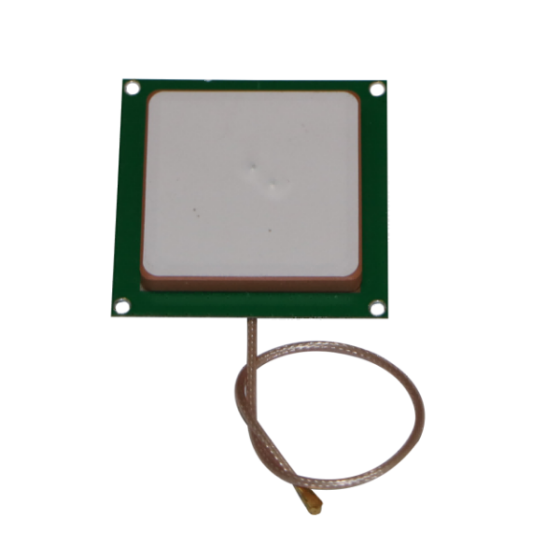
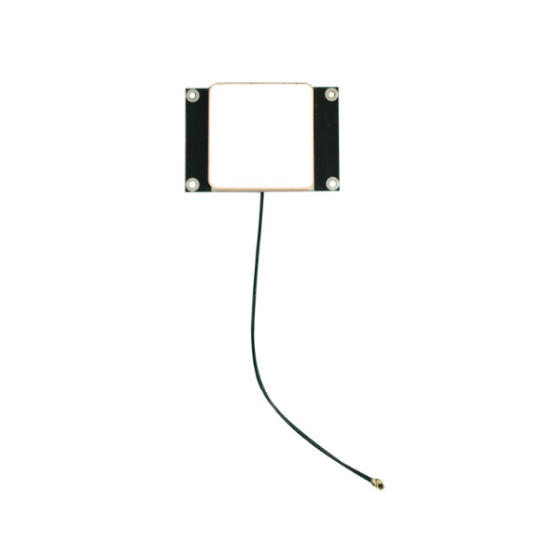
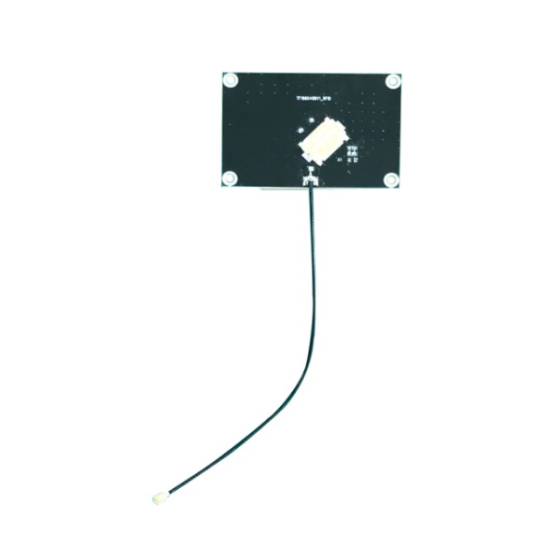
An RFID reader communicates with an RFID tag using radio-frequency signals. The reader sends a signal through its antenna, the tag detects the signal, and the RFID chip processes the reader's request. The tag then sends information back to the reader, which passes the data to connected software for identification, tracking, or inventory management.
Unlike a barcode scanner, an RFID reader does not normally need to visually see the tag. This wireless communication is what makes RFID useful for tracking products, equipment, containers, tools, and other assets.
What Is RFID Communication?
RFID communication is the wireless exchange of information between an RFID reader and an RFID tag.
A typical communication process looks like this:
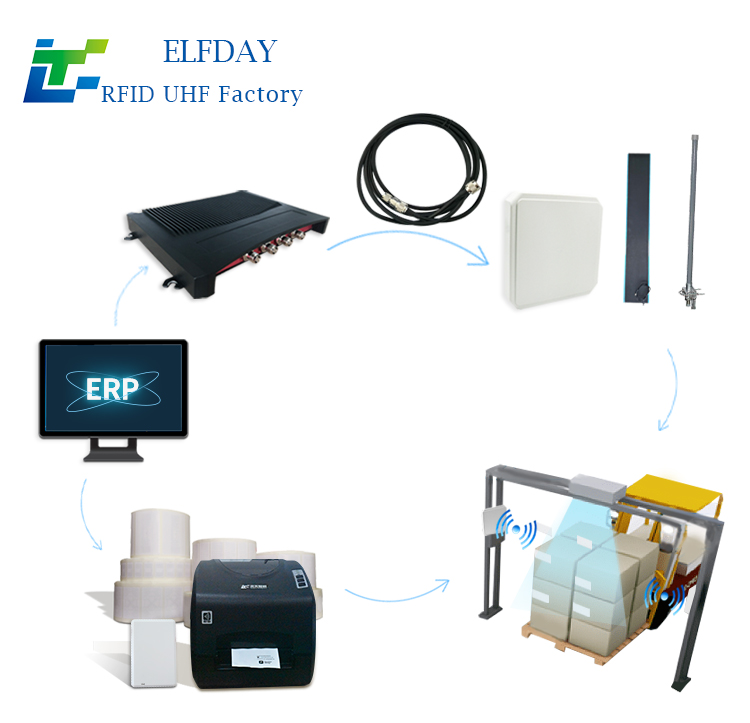
RFID reader → radio signal → RFID tag → tag response → RFID reader → software system
The reader acts as the system's communication point, while the RFID tag responds when it receives a suitable signal.
Depending on the RFID technology, the tag may also use the energy from the reader's signal to power its chip.
What Happens When an RFID Reader Detects a Tag?
When an RFID reader encounters an RFID tag within its operating range, several steps take place.
1. The Reader Generates a Radio Signal
The RFID reader generates a radio-frequency signal and sends it through its antenna.
The exact frequency depends on the RFID system.
Common RFID frequency categories include:
-
Low Frequency (LF)
-
High Frequency (HF)
-
Ultra-High Frequency (UHF)
Different frequency ranges have different communication characteristics and are suited to different applications.
2. The Tag Receives the Signal
The RFID tag's antenna detects the incoming radio signal.
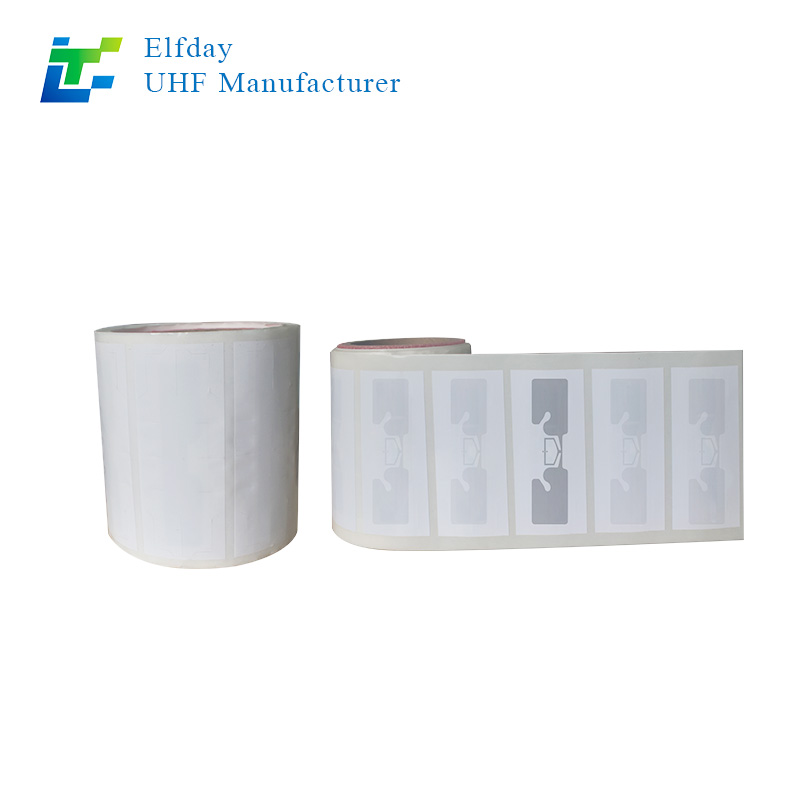
For a passive RFID tag, the signal from the reader can provide the energy required for the RFID chip to operate.
Active RFID tags work differently because they have their own power source.
3. The RFID Chip Processes the Request
Once the chip receives enough energy and detects the reader's communication, it processes the incoming command.
The reader may request information such as the tag's identification number or other available memory data.
4. The Tag Sends a Response
The RFID tag responds by communicating information back to the reader.
For passive UHF RFID systems, this commonly involves backscatter communication. Rather than generating a strong radio signal of its own, the tag changes how it interacts with the reader's signal to send information back.
5. The Reader Receives the Data
The reader's antenna detects the response from the tag.
The reader then processes the radio-frequency communication and converts it into usable digital information.
6. The Software Uses the Information
The reader can send the captured tag data to connected software.
The system may then use the information to:
-
Identify an item
-
Update inventory
-
Track an asset
-
Record a movement
-
Confirm receiving
-
Support production processes
-
Trigger another business process
This entire sequence can happen very quickly.
How Does a Passive RFID Tag Communicate?
Passive RFID tags do not normally contain their own battery.
Instead, they rely on the electromagnetic energy provided by the RFID reader.
A simplified process is:
Reader sends energy → tag receives energy → chip activates → tag processes command → tag responds → reader receives data
This design allows passive tags to be relatively small and suitable for applications such as product identification, inventory management, asset tracking, and logistics.
What Is Backscatter Communication?
Backscatter is a key communication method used by many passive RFID systems, particularly UHF RFID.
The RFID reader sends a continuous radio-frequency signal toward the tag.
The tag's chip controls how its antenna interacts with that signal. By changing the antenna's electrical characteristics in a controlled way, the tag can modulate the reflected signal.
The reader detects these changes and interprets them as digital information.
A simplified explanation is:
Reader transmits signal → tag changes reflected signal → reader detects changes → data is decoded
The tag is therefore able to communicate without needing to generate a conventional radio transmission using its own battery.
Does the RFID Reader Send Data to the Tag?
Yes.
RFID communication is not simply a one-way process.
The reader can send commands to the tag, and the tag can respond.
Depending on the RFID system and tag capabilities, communication may involve operations such as:
-
Selecting tags
-
Identifying tags
-
Reading memory
-
Writing memory
-
Accessing protected memory
-
Managing tag states
This allows RFID systems to do more than simply detect whether a tag is nearby.
Can an RFID Reader Communicate With Multiple Tags?
Yes, many RFID systems can communicate with multiple tags within the reader's operating area.
This capability is one of the major advantages of RFID for inventory and asset tracking.
Imagine a warehouse receiving area containing dozens of tagged cartons.
Instead of scanning each barcode individually, an RFID reader can communicate with multiple tags within its read zone.
The system manages the communication process so that tags can respond without all attempting to communicate at exactly the same time.
This is generally referred to as anti-collision technology.
What Is RFID Anti-Collision?
When multiple RFID tags are within the reader's range, their signals could potentially overlap.
RFID communication protocols use anti-collision methods to manage this situation.
A simplified sequence might look like:
Reader detects multiple tags → tags are separated by the protocol → reader communicates with individual tags → tag IDs are collected
This allows an RFID reader to identify many items during a single reading operation.
The exact method depends on the RFID technology and communication protocol being used.
How Does the Reader Know Which Tag to Talk To?
The reader uses commands defined by the relevant RFID protocol to manage communication with tags.
In a multi-tag environment, the reader can organize which tags respond and when they respond.
For example, a reader in a warehouse could encounter:
-
Tag A — pallet
-
Tag B — carton
-
Tag C — carton
-
Tag D — tool
-
Tag E — equipment
The reader and RFID protocol coordinate the communication so the system can identify the individual tags.
What Information Does the RFID Tag Send?
The exact information depends on the RFID tag and system configuration.
An RFID tag may provide:
-
Unique tag ID
-
EPC
-
TID-related information
-
User memory
-
Product identifier
-
Asset identifier
-
Serial number
-
Other application-specific information
In many systems, the tag primarily provides a unique identifier.
The software then uses that identifier to retrieve detailed information from a database.
For example:
RFID tag → Asset ID 100245 → database → Forklift #12
This means the RFID tag does not necessarily need to store the entire asset record.
Does RFID Require Line of Sight?
No, RFID generally does not require direct line of sight between the reader and tag.
Radio waves can communicate with a tag even when the tag is not directly visible to the reader.
This is one of the main differences between RFID and optical technologies such as barcodes.
However, RFID performance can still be affected by physical conditions.
Factors such as:
-
Metal
-
Water
-
Tag orientation
-
Reader power
-
Antenna design
-
Operating frequency
-
Interference
-
Distance
can influence communication performance.
How Does Metal Affect RFID Communication?
Metal can significantly influence RFID performance, particularly when a tag is not designed for mounting on metal.
Metal can interact with the electromagnetic field and affect the tag antenna's performance.
For industrial applications involving:
-
Machinery
-
Steel containers
-
Metal tools
-
Vehicles
-
Equipment
-
Metal racks
specialized on-metal RFID tags may be used.
These tags are designed with constructions that help maintain more reliable communication when attached to metal surfaces.
What Happens if Several Readers Are Nearby?
Multiple RFID readers operating in the same environment can potentially interfere with one another if the system is not properly designed.
RFID installations may therefore consider:
-
Reader placement
-
Antenna positioning
-
Operating channels
-
Reader power
-
Read zones
-
Timing
-
Environmental interference
A well-designed RFID system aims to create predictable communication zones and minimize unwanted reads or interference.
RFID Reader Communication by Frequency
Different RFID technologies communicate in different ways.
| RFID Type | Typical Frequency | Common Characteristics |
|---|---|---|
| LF RFID | Around 125–134 kHz | Shorter read range, often used for specialized identification |
| HF RFID | 13.56 MHz | Common in access control, cards, and item identification |
| UHF RFID | Around 860–960 MHz | Longer read ranges and strong suitability for inventory and logistics |
The actual frequency ranges and regulatory requirements can vary by region.
Each technology also uses different communication methods and has different performance characteristics.
RFID Reader vs. RFID Tag: What Does Each Component Do?
| Component | Main Role |
|---|---|
| RFID reader | Generates signals, sends commands, receives tag responses |
| RFID reader antenna | Transmits and receives radio-frequency signals |
| RFID tag antenna | Receives reader signals and communicates the tag response |
| RFID chip | Processes commands and manages stored information |
| RFID software | Processes and uses the captured RFID data |
Together, these components create the complete RFID communication system.
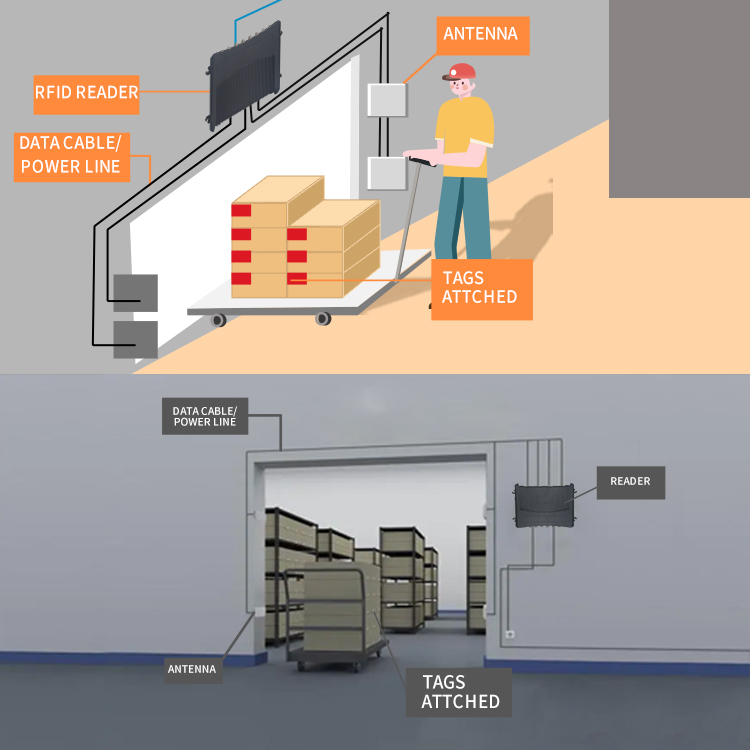
A Real-World Example: RFID in a Warehouse
Consider a warehouse where pallets are tagged with RFID labels.
A pallet approaches a receiving area.
Step 1
The RFID reader continuously monitors its configured read zone.
Step 2
The pallet's RFID tag enters the reader's operating range.
Step 3
The tag receives the reader's signal.
Step 4
The RFID chip activates and responds according to the communication protocol.
Step 5
The reader captures the tag's identifier.
Step 6
The warehouse software receives the RFID data.
Step 7
The system identifies the pallet and updates the relevant inventory record.
The employee does not necessarily need to stop and scan the tag manually.
This is one reason RFID can be useful for automating repetitive identification tasks.
Why Is RFID Communication Useful?
RFID reader-to-tag communication can provide several operational benefits.
Faster Identification
Readers can capture tag information quickly without requiring manual barcode scanning.
Reduced Manual Data Entry
Automated RFID reading can reduce the amount of information employees need to enter manually.
Multiple-Item Reading
Many RFID systems can identify multiple tags within the reader's communication area.
Improved Tracking
Each tagged object can have a digital identity that can be captured at different points in a process.
Automation
RFID data can be integrated into inventory, manufacturing, warehouse, logistics, and asset-management workflows.
Frequently Asked Questions
How does an RFID reader communicate with an RFID tag?
An RFID reader sends a radio-frequency signal through its antenna. The tag receives the signal, processes the reader's request, and sends information back to the reader. The reader then passes the data to connected software.
Does an RFID tag transmit a signal?
It depends on the tag type. Passive RFID tags typically communicate by modifying or backscattering the reader's signal, while active RFID tags have their own power source and can transmit signals using that power.
Can RFID readers read multiple tags at once?
Yes. Many RFID systems are designed to identify multiple tags within the reader's operating area using anti-collision communication techniques.
Does RFID work without Wi-Fi?
RFID communication between a reader and tag does not require Wi-Fi. However, the RFID reader may use Wi-Fi, Ethernet, cellular connectivity, or another network connection to send collected data to a larger software system.
How far can an RFID reader communicate with a tag?
There is no single read distance for all RFID systems. The range depends on the RFID frequency, tag type, antenna design, reader power, tag orientation, environment, and other factors.
Can an RFID reader write data to a tag?
Yes, if the RFID tag has writable memory and the RFID system supports writing. The reader can send commands that allow authorized information to be stored or updated on the tag.
An RFID reader communicates with an RFID tag by exchanging information through radio-frequency signals. The reader sends a signal and commands, the tag receives and processes them, and the tag responds with its identification or stored information.
For passive RFID systems, the reader's signal can also provide the energy needed for the tag to operate. Through technologies such as backscatter communication and anti-collision protocols, an RFID reader can identify individual tags and, in many systems, multiple tags within its operating area.
This wireless communication process is what allows RFID to support automated identification and tracking across retail, warehousing, manufacturing, logistics, healthcare, and industrial asset management.