



How Does RFID Backscatter Communication Work? A Simple Guide
RFID backscatter communication allows a passive RFID tag to send data back to an RFID reader by changing how it reflects the reader's radio signal. Instead of generating a strong radio signal of its own, the tag uses the electromagnetic energy from the reader and modulates the reflected signal to communicate information.
This technology is especially important in passive UHF RFID systems, where tags need to operate without their own batteries.
Understanding backscatter helps explain why a small, battery-free RFID tag can communicate wirelessly with a reader.
What Is RFID Backscatter Communication?
RFID backscatter is a communication method in which an RFID tag modifies and reflects an incoming radio-frequency signal to send information back to the reader.
The basic process is:
Reader transmits RF signal → RFID tag receives energy → tag changes its antenna state → signal is reflected differently → reader detects the changes → data is decoded
The tag is not simply reflecting the signal like a mirror.
Instead, its RFID chip rapidly changes the electrical characteristics of the tag antenna. These controlled changes affect the reflected signal in a way that represents digital information.
Why Do Passive RFID Tags Use Backscatter?
Passive RFID tags typically do not have their own batteries.
That creates an important challenge: how can a battery-free tag communicate with a reader?
The solution is to use the reader's transmitted RF energy.
A passive tag can:
-
Receive energy from the reader.
-
Use that energy to power its chip.
-
Receive commands from the reader.
-
Change its antenna's electrical state.
-
Reflect the reader's signal in a controlled pattern.
-
Send encoded information back to the reader.
This allows the tag to communicate without needing a separate transmitter and battery.
How Does RFID Backscatter Work Step by Step?
Step 1: The Reader Sends a Radio Signal
The RFID reader generates a radio-frequency signal and transmits it through its antenna.
For many inventory and logistics applications, this occurs in the UHF RFID frequency range.
The transmitted signal performs two important functions:
-
It provides energy that can activate a passive tag.
-
It provides the carrier signal that the tag can use for backscatter communication.
Step 2: The RFID Tag Receives the Signal
When the tag enters the reader's electromagnetic field, its antenna captures some of the available RF energy.
The tag's chip uses this energy to power its internal circuits.
Once the chip has sufficient energy, it can process commands from the reader.
Step 3: The Reader Sends a Command
The reader can communicate with the tag by sending commands defined by the RFID communication protocol.
The tag processes the command and determines how it should respond.
For example, the reader may request the tag's identification information.
Step 4: The Tag Changes Its Electrical State
This is the key part of backscatter communication.
The RFID chip controls a circuit connected to the tag antenna.
By switching between different electrical states, the chip changes how the antenna interacts with the incoming RF signal.
This changes the characteristics of the signal reflected toward the reader.
Step 5: The Reflected Signal Carries Data
The changes in the reflected signal represent digital information.
The tag can therefore communicate information such as:
-
Tag identification
-
EPC data
-
Other available memory
-
Protocol-related information
The information is encoded into the tag's backscatter response.
Step 6: The Reader Detects the Changes
The reader receives the reflected signal through its antenna.
It analyzes the changes in the signal and decodes them according to the relevant RFID protocol.
The result is usable digital data.
The complete process can be simplified as:
RF energy → tag activation → chip control → antenna switching → modulated reflection → reader detection → digital data
Is the RFID Tag Actually Sending a Radio Signal?
This is an important distinction.
A passive RFID tag is not normally generating a conventional radio-frequency transmission in the same way as an active radio transmitter.
Instead, it changes how it reflects the signal that the reader has already transmitted.
A useful analogy is a flashlight and a mirror.
Imagine that a flashlight shines toward a mirror. If the mirror can rapidly change between two different reflective states, someone observing the reflected light could detect those changes and interpret them as information.
RFID backscatter works on a similar principle, although the actual electronics and electromagnetic behavior are much more sophisticated.
What Is the Role of the RFID Antenna?
The antenna is essential to backscatter communication.
An RFID tag antenna has two major roles:
-
Receive energy and signals from the reader
-
Interact with the reader's signal to send information back
The antenna is connected to the RFID chip.
The chip controls the electrical load connected to the antenna. Changing this load changes the way the antenna interacts with the incoming RF field.
This controlled interaction creates the backscatter response.
What Does the RFID Chip Do?
The RFID chip acts as the electronic control center of the tag.
It can:
-
Receive reader commands
-
Manage stored data
-
Process protocol instructions
-
Control the antenna's electrical state
-
Modulate the backscatter response
-
Manage memory access
-
Perform other tag-specific functions
The chip therefore turns the physical behavior of the antenna into a method of digital communication.

How Does the Tag Encode Data?
RFID tags need a way to represent digital information through changes in the backscattered signal.
The tag uses modulation techniques defined by the applicable RFID protocol.
In simplified terms, the chip switches between different states according to the data it needs to send.
The reader observes these changes and interprets them as bits of information.
For example:
Tag data → digital bits → modulation → antenna state changes → backscattered signal → reader decoding
The actual signaling is more complex than this simplified representation, but the basic concept is the same.
What Is Load Modulation?
Load modulation is the process of changing the electrical load associated with an RFID antenna to influence the signal that is reflected or coupled back toward the reader.
In passive UHF RFID systems, the tag's chip can switch its impedance between different states.
These changes affect the electromagnetic interaction between the tag and reader.
The reader detects the resulting changes and uses them to recover the tag's data.
This is one of the fundamental concepts behind RFID backscatter.
Why Is Backscatter Efficient?
Backscatter allows the tag to avoid having a full radio transmitter.
A conventional wireless transmitter generally needs to generate and amplify its own RF signal.
A passive RFID tag can instead make use of an existing signal from the reader.
This can reduce the tag's power requirements and enables very small, battery-free devices.
As a result, passive RFID tags can be manufactured in compact formats and integrated into:
-
Product labels
-
Packaging
-
Cards
-
Industrial tags
-
Asset labels
-
Pallet tags
-
Logistics labels
Backscatter vs. Active RFID Communication
Backscatter is particularly associated with passive RFID, but not every RFID system works in exactly the same way.
| Feature | Passive RFID | Active RFID |
|---|---|---|
| Battery | Usually no | Yes |
| Reader provides energy | Yes | Not normally required |
| Tag transmission | Uses backscatter or related passive communication | Can actively transmit |
| Tag size | Often compact | Generally larger |
| Typical use | Inventory, retail, logistics, asset identification | Longer-range tracking and specialized applications |
Active RFID systems have their own power source, giving them different communication and range characteristics.
Why Does Backscatter Matter for UHF RFID?
Backscatter is particularly important for UHF RFID because it enables passive tags to communicate over relatively useful distances while maintaining low power requirements.
This makes UHF RFID suitable for applications where many items need to be identified efficiently.
Common examples include:
-
Warehouse inventory
-
Retail stock management
-
Pallet tracking
-
Supply chain operations
-
Manufacturing
-
Industrial asset tracking
-
Reusable container tracking
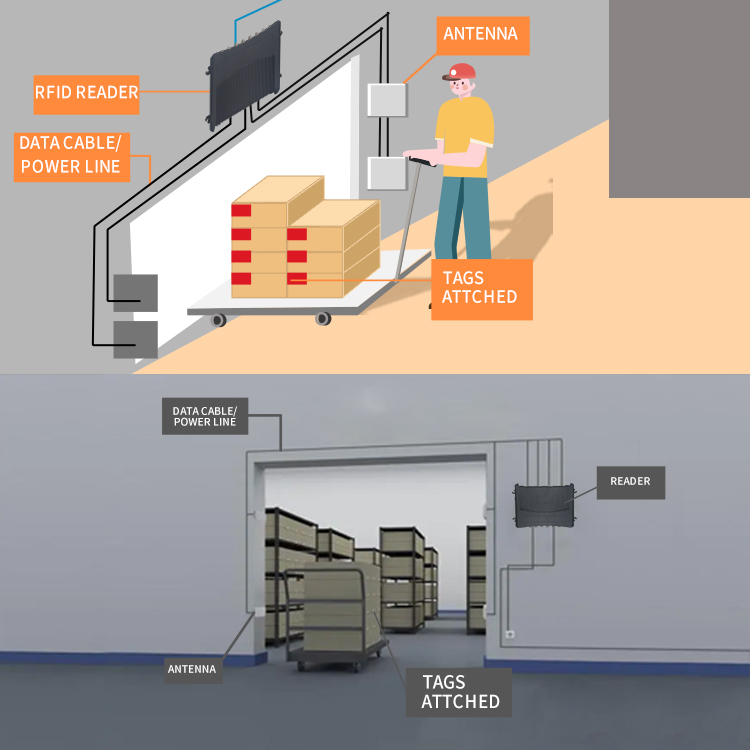
A reader can create a read zone, and passive tags entering that zone can respond using backscatter communication.
What Affects RFID Backscatter Performance?
Backscatter communication is influenced by both the tag and its surrounding environment.
Important factors include:
Tag Antenna Design
The antenna determines how efficiently the tag receives energy and produces its backscatter response.
Reader Power
The reader's transmitted power affects how much energy reaches the tag and how strong the communication environment is.
Distance
As the distance between the reader and tag increases, the available RF energy decreases and the returned signal becomes more difficult to detect.
Tag Orientation
The relative orientation of the tag antenna and reader antenna can affect communication performance.
Material
Metal and liquids can significantly influence RF behavior.
A standard RFID label may perform differently when attached to:
-
Cardboard
-
Plastic
-
Glass
-
Metal
-
Liquid-containing products
Reader Antenna Position
The placement and orientation of the reader antenna influence the electromagnetic field and therefore the read zone.
Why Does Metal Affect Backscatter?
Metal can interact strongly with electromagnetic fields.
When a conventional RFID tag is placed directly on metal, the metal can alter the behavior of the tag antenna and reduce communication performance.
This is why specialized on-metal RFID tags are often used for:
-
Machinery
-
Steel containers
-
Industrial equipment
-
Metal tools
-
Vehicles
-
Metal racks
These tags are designed to maintain more suitable antenna behavior when mounted on conductive surfaces.
Can Multiple RFID Tags Use Backscatter at the Same Time?
An RFID reader may encounter many tags within its operating area.
If all tags responded simultaneously, their signals could interfere with one another.
RFID communication protocols therefore include mechanisms for managing multiple tags.
A simplified sequence is:
Reader detects multiple tags → communication protocol organizes responses → individual tags respond → reader collects tag data
This allows a reader to identify multiple tagged objects during an inventory or tracking operation.
How Does Backscatter Support RFID Inventory Management?
Imagine a warehouse pallet carrying dozens of RFID-tagged products.
The pallet enters an RFID reader's operating zone.
The reader sends an RF signal.
Each passive tag receives energy and responds using backscatter communication.
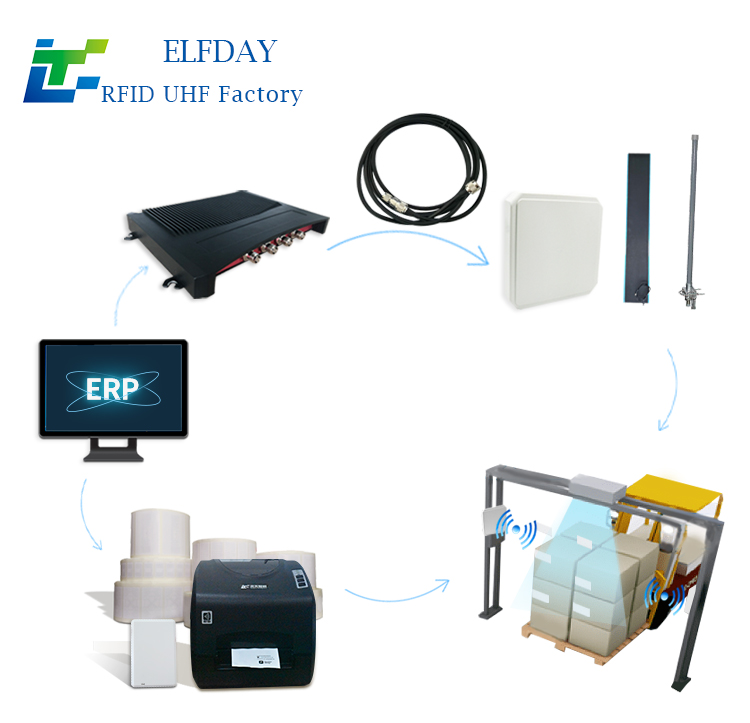
The reader collects the tag responses and sends the resulting information to the inventory system.
The process can look like this:
Pallet enters read zone → tags receive RF energy → tags respond → reader collects IDs → software updates inventory
This can reduce the need for employees to individually scan every item.
Does Backscatter Store Data?
No.
Backscatter is a communication method, not a storage method.
The RFID chip stores data in its memory.
Backscatter is the method used to communicate that data back to the reader.
A useful distinction is:
RFID chip memory = where data is stored
Backscatter communication = how passive tags send data back
Keeping these two concepts separate makes RFID systems much easier to understand.
Does Every RFID Tag Use Backscatter?
No.
Different RFID technologies use different communication mechanisms.
Backscatter is particularly important in passive UHF RFID systems.
LF, HF, UHF, passive, active, and battery-assisted RFID technologies can have different operating principles.
Therefore, the exact communication method depends on the RFID system being used.
Frequently Asked Questions
How does RFID backscatter communication work?
A reader sends a radio-frequency signal toward the RFID tag. The passive tag uses some of the signal's energy to power its chip and changes the electrical state of its antenna to modulate the reflected signal. The reader detects these changes and decodes them into data.
Does a passive RFID tag need a battery?
Generally, no. Passive RFID tags obtain operating energy from the radio-frequency signal transmitted by the reader.
Does the RFID tag create its own signal?
A passive RFID tag generally does not generate a conventional RF transmission. Instead, it modifies and backscatters the signal transmitted by the reader.
What is backscatter in simple terms?
Backscatter means using an incoming radio signal as the basis for communication by changing how that signal is reflected back toward the reader.
Why is backscatter used in RFID?
Backscatter allows passive RFID tags to communicate without requiring their own battery-powered transmitter. This enables small, low-power, and relatively inexpensive tags.
What is the difference between RFID backscatter and Bluetooth?
Bluetooth devices normally use active radio transmitters powered by batteries or another energy source. Passive RFID tags can communicate through backscatter using energy supplied by the RFID reader.
Can backscatter RFID work through packaging?
It depends on the packaging and materials involved. Paperboard and many plastics can be suitable, while metal and liquid-heavy environments can create additional challenges. Tag design and placement are important.
RFID backscatter communication works by allowing a passive RFID tag to modify and reflect a radio signal transmitted by an RFID reader. The reader supplies the RF energy, the tag's chip controls the antenna's electrical state, and the resulting changes in the reflected signal encode information.
The key idea is simple:
The reader sends the signal → the tag changes the reflection → the reader detects the changes → the system recovers the data.
Because passive RFID tags can communicate without their own batteries, backscatter technology is a foundation of many UHF RFID applications. It enables wireless identification and tracking across retail, warehouses, manufacturing, logistics, supply chains, and industrial asset management.