



Does RFID Tag Orientation Affect Read Performance? A Practical Guide
Yes, RFID tag orientation can affect read performance. The angle and position of an RFID tag relative to the reader antenna can influence how effectively radio-frequency energy reaches the tag and how reliably the tag responds.
When an RFID tag is positioned correctly, the reader may identify it quickly and consistently. When the tag is turned at an unfavorable angle, placed too close to certain materials, or positioned outside the strongest part of the reader's field, read performance may decrease.
This is particularly important in warehouses, retail environments, manufacturing facilities, logistics operations, and asset-tracking applications where tags may naturally move into different positions.
Why Does RFID Tag Orientation Matter?
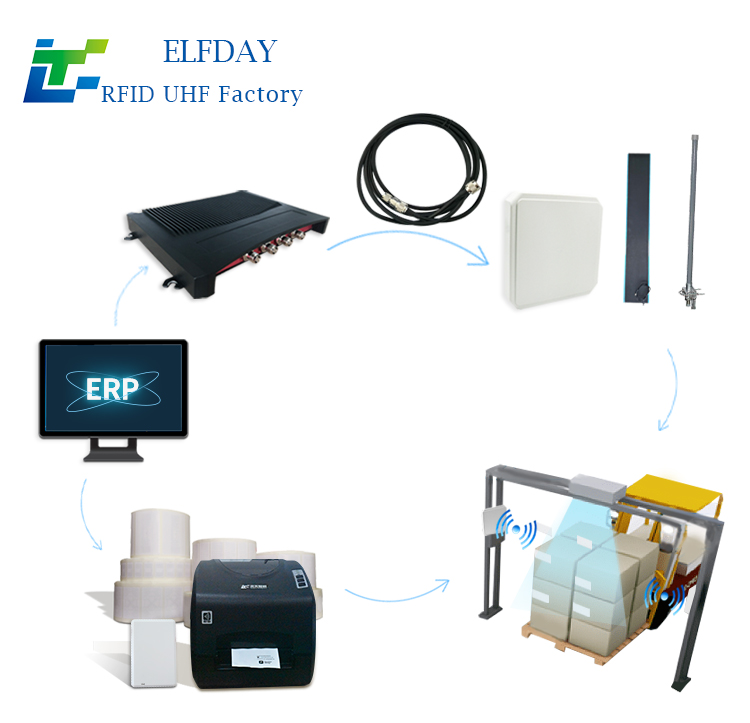
An RFID system depends on communication between the reader antenna and the RFID tag antenna.
A simplified process looks like this:
RFID reader → radio signal → RFID tag antenna → RFID chip → tag response → reader
For the communication to work effectively, the tag needs to interact with the electromagnetic field generated by the reader.
The orientation of the tag can affect this interaction.
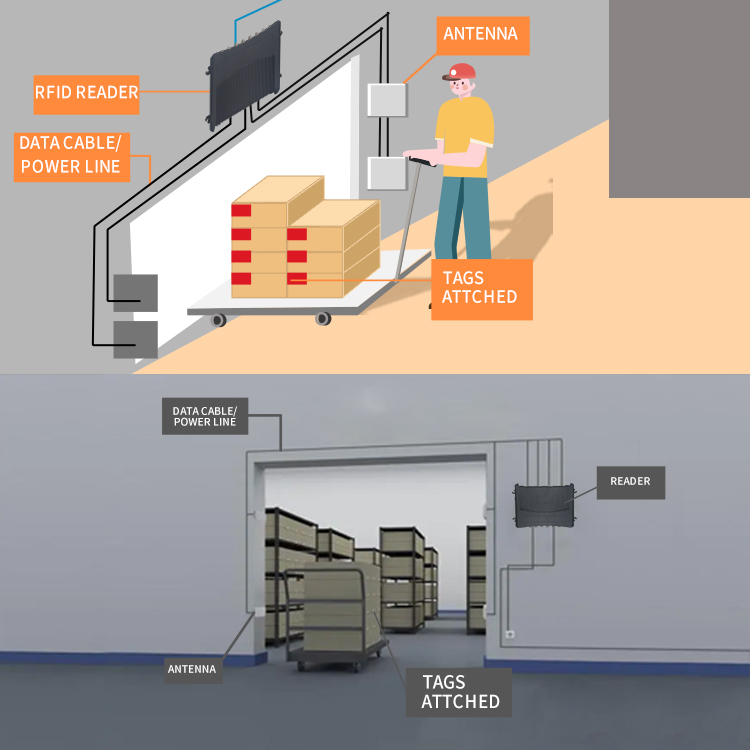
For example, imagine several boxes moving through an RFID portal. If every tag is positioned in a similar direction, the system may achieve consistent reads. If some tags are rotated, tilted, or attached to different surfaces, their read performance may vary.
This does not mean an RFID tag must always face the reader directly. RFID systems are designed to support practical variations in tag position. However, orientation becomes an important consideration when maximum read reliability is required.
How Does RFID Tag Orientation Affect Read Performance?
Several factors connect tag orientation with RFID performance.
1. Tag and Reader Antenna Alignment
The relationship between the tag antenna and reader antenna is one of the most important considerations.
When the two antennas are appropriately aligned, the tag can interact more effectively with the reader's RF field.
Poor alignment can reduce the amount of usable energy reaching the tag or weaken the tag's response.
This can result in:
-
Shorter effective read range
-
Slower tag identification
-
Inconsistent reads
-
Missed reads in difficult positions
The exact effect depends on the RFID frequency, antenna design, reader configuration, and application.
2. Tag Angle
A tag does not always have to be perfectly parallel to the reader antenna.
However, changing the angle can change the way the tag interacts with the electromagnetic field.
For example:
Optimal orientation → stronger interaction → more reliable reading
while:
Unfavorable orientation → weaker interaction → potentially reduced reading reliability
This is especially noticeable when a tag is placed on an item that rotates or moves during handling.
3. Distance From the Reader
Orientation and distance often work together.
A tag positioned at an unfavorable angle may still be readable when it is close to the reader. As the tag moves farther away, however, the reduced signal interaction may become more significant.
This means a tag that works reliably during testing at short range may behave differently in a larger warehouse or portal.
Does RFID Orientation Affect Read Range?
It can.
Read range is influenced by many factors, including:
-
RFID frequency
-
Reader output power
-
Reader antenna design
-
Tag antenna design
-
Tag orientation
-
Tag size
-
Tag placement
-
Surrounding materials
-
Environmental interference
Orientation is therefore only one part of the overall read-range equation.
A well-designed RFID tag may perform effectively across a range of angles, but its maximum practical read distance can still change as its position changes.
RFID Tag Orientation and Polarization
Polarization is an important technical concept when discussing RFID orientation.
Reader antennas can generate electromagnetic fields with different polarization characteristics. RFID tag antennas also have an orientation that affects how they interact with these fields.
When the tag and reader antenna polarization are well matched, communication can be more effective.
When they are poorly matched, signal coupling can decrease.
This is one reason RFID system designers sometimes use antenna configurations that provide greater tolerance for changing tag orientations.
Linear vs. Circular Polarization
For many UHF RFID applications, reader antenna polarization is an important design choice.
Linear Polarization
A linearly polarized antenna produces an electromagnetic field oriented along a particular direction.
This can work very well when tagged items have a predictable orientation.
For example, if products always travel through a reader portal in approximately the same position, a linearly polarized antenna can be suitable.
However, if tags can rotate significantly, performance may become less consistent.
Circular Polarization
Circularly polarized antennas can provide greater tolerance when tags appear at different angles.
This can be useful when:
-
Products are randomly oriented
-
Packages rotate on conveyors
-
Items are manually handled
-
Tags can face different directions
-
Asset positions are difficult to control
Circular polarization does not eliminate orientation effects, but it can help reduce sensitivity to tag rotation in suitable applications.
Does Tag Placement Matter More Than Orientation?
Orientation and placement are closely related, and both can affect RFID performance.
A tag may have a good orientation but still perform poorly because it is attached to an unsuitable location.
For example, placing a standard RFID tag directly against metal can significantly affect its performance if the tag was not designed for metal surfaces.
Similarly, liquids can influence UHF RFID performance because they can absorb or alter RF energy.
Consider these examples:
| Barcode | Potential Consideration |
| Cardboard box | Usually relatively RFID-friendly |
| Plastic container | Often suitable, depending on material |
| Metal surface | May require an on-metal RFID tag |
| Near large amounts of liquid | May require careful tag selection and testing |
| Inside dense packaging | Read performance may vary |
| Between closely packed products | Reader and tag positioning become important |
Therefore, simply changing the tag angle may not solve a problem caused by the surrounding material.
How Tag Orientation Changes in Real-World Applications
One of the biggest challenges with RFID is that tagged objects do not always remain stationary.
Warehouse Inventory
Products may be placed on shelves at different angles.
Some tags may face forward, while others face sideways or backward.
A properly designed RFID installation needs to account for these variations.
Conveyor Systems
Products can rotate as they move along a conveyor.
A tag that initially faces the reader may become angled as the item moves through the reading zone.
In this situation, antenna positioning and polarization become particularly important.
Retail
Clothing, packaged products, and other retail items can be moved, stacked, or rearranged frequently.
The tag may not remain in a fixed orientation during inventory checks.
Asset Tracking
Tools, equipment, containers, and industrial assets may be placed in unpredictable positions.
For these applications, the RFID system should be tested under realistic conditions rather than assuming every tag will maintain an ideal angle.
Can RFID Tags Be Read From Different Angles?
Yes.
RFID tags can often be read from multiple angles, but the performance may not be identical at every orientation.
The practical reading angle depends on:
-
Tag antenna design
-
Reader antenna design
-
RFID frequency
-
Reader power
-
Distance
-
Polarization
-
Tag material and size
-
Surrounding environment
A tag that performs well at one angle may have a shorter read distance at another.
For this reason, RFID system testing should include realistic tag positions rather than testing only one ideal orientation.
How to Improve RFID Read Performance When Orientation Varies
If tagged items can appear in different orientations, several approaches can help.
1. Test Multiple Tag Orientations
During system testing, deliberately rotate the tag through different angles.
For example:
0° → 45° → 90° → 135° → 180°
Measure whether the tag remains consistently detectable at each position.
This provides a more realistic understanding of system performance.
2. Choose the Right Reader Antenna
Reader antenna selection should match the application's expected tag orientation.
If products have predictable positioning, a directional configuration may work well.
If tag orientation varies significantly, a configuration with greater angular tolerance may be more appropriate.
3. Optimize Antenna Placement
Reader antennas should be positioned according to how tagged objects actually move.
Instead of asking only:
Where can the antenna be installed?
consider:
Where will the tag be when it needs to be read?
This approach helps account for tag movement, height, angle, and distance.
4. Select the Appropriate RFID Tag
Different RFID tags are designed for different environments.
For example, a tag intended for cardboard packaging may not be appropriate for a metal asset.
Tag selection should consider:
-
Surface material
-
Available mounting space
-
Expected reading distance
-
Environmental conditions
-
Tag orientation
-
Required durability
5. Use Multiple Antennas When Necessary
Some RFID applications involve unpredictable tag positions.
Using multiple reader antennas can increase the likelihood that a tag enters a suitable RF field from at least one direction.
This can be useful for:
-
RFID portals
-
Conveyor systems
-
Warehouse entrances
-
Large asset tracking areas
-
High-volume inventory points
However, adding antennas is not automatically the best solution. Antenna placement, interference, reader configuration, and the physical environment still need to be considered.
A Simple Example: RFID Tags on Boxes
Imagine a warehouse where 100 boxes pass through an RFID reading area.
If all boxes have tags positioned in roughly the same direction, the system may produce highly consistent results.
Now suppose the boxes are randomly rotated.
Some tags may still be read immediately, while others may require a better position within the reader's field.
The difference can be represented simply as:
Consistent tag orientation → predictable RF interaction
Random tag orientation → more variable RF interaction
This is why real-world RFID testing should reproduce the actual movement and positioning of products.
RFID Orientation vs. Barcode Scanning
RFID and barcode technologies respond differently to positioning.
| Factor | RFID | Barcode |
| Direct visibility | Usually not required | Generally required |
| Reading direction | More flexible | More directional |
| Multiple items | Can identify multiple tags | Usually scanned individually |
| Sensitivity to orientation | Yes, depending on system | High |
| Optical alignment | Not required | Required |
| Material effects | Can be significant | Usually less related to RF behavior |
RFID provides greater flexibility than optical barcode scanning, but that does not mean tag orientation is irrelevant.
RF performance still depends on how the tag interacts with the reader's electromagnetic field.
Does RFID Tag Orientation Affect All RFID Technologies?
Not in exactly the same way.
RFID systems can operate at different frequencies, including LF, HF, and UHF.
Their operating principles, coupling mechanisms, antenna designs, and typical applications differ.
UHF RFID systems are particularly relevant when discussing long-range reading and changing tag orientation because they commonly use far-field electromagnetic communication.
HF RFID systems, by contrast, generally operate at shorter distances and rely heavily on inductive coupling.
Therefore, the effect of orientation depends partly on the RFID technology being used.
What Should You Consider When Testing RFID Tag Orientation?
A practical RFID orientation test should consider more than just rotating the tag.
Test variables can include:
-
Tag angle
-
Reader-to-tag distance
-
Tag height
-
Reader antenna position
-
Product material
-
Tag mounting location
-
Product movement
-
Tag density
-
Reader power
-
Environmental interference
A useful test process is:
Choose representative products
↓
Apply RFID tags in realistic positions
↓
Rotate tags through different orientations
↓
Test at different distances
↓
Move products at normal operating speeds
↓
Record successful and missed reads
↓
Adjust tag and reader positioning
This approach provides much more useful information than testing a single tag on a stationary table.
Common RFID Orientation Mistakes
Assuming Every Tag Must Face the Reader
RFID does not require every tag to be perfectly face-on.
The system can often tolerate a range of orientations.
The goal is not necessarily to create a perfect angle for every tag, but to achieve reliable performance under normal operating conditions.
Ignoring Product Rotation
A tag may be correctly positioned during installation but rotate during transportation.
This is common with boxes, containers, pallets, and conveyor-based systems.
Testing Only Empty Packaging
A tag may behave differently when attached to the actual product.
Metal, liquids, dense materials, and other objects can influence RFID performance.
Testing should therefore use representative products whenever possible.
Focusing Only on Maximum Read Range
A long theoretical read range does not necessarily mean better system performance.
For many applications, consistent reads are more important than achieving the maximum possible distance.
FAQs
Does RFID tag orientation affect read performance?
Yes. Tag orientation can affect how effectively the RFID tag interacts with the reader's RF field. The impact depends on the tag, reader antenna, polarization, distance, frequency, and surrounding environment.
Does an RFID tag need to face the reader?
No. RFID tags do not generally need to face the reader directly. However, certain orientations can provide better performance than others.
Can RFID tags be read sideways?
Yes. RFID tags can often be read when positioned sideways or at an angle. The actual performance depends on the RFID system and tag orientation.
What happens if an RFID tag is rotated?
Rotating a tag can change its interaction with the reader's electromagnetic field. Depending on the system, this may reduce read range or make reads less consistent.
Does tag orientation affect UHF RFID?
Yes. Orientation can be particularly relevant to UHF RFID because tag and reader antenna characteristics influence how efficiently RF energy is exchanged.
How can I improve RFID reading when tag orientation varies?
Consider suitable reader antenna polarization, antenna placement, multiple antennas where appropriate, correct tag selection, and testing under realistic tag positions and movement conditions.
RFID tag orientation can affect read performance, but it is only one part of the overall RFID system.
The relationship between the tag antenna, reader antenna, polarization, distance, tag placement, surrounding materials, and product movement all contribute to reading reliability.
For applications where tagged items can rotate or appear in unpredictable positions, the best approach is to test the complete RFID setup under real operating conditions.
Instead of optimizing for one perfect tag angle, aim for a system that can consistently identify tags across the range of orientations that will occur in everyday use.
That makes RFID deployment more predictable and helps reduce missed reads in warehouses, retail operations, manufacturing, logistics, and asset-tracking environments.