



Can RFID Tags Be Used on Glass? A Practical Guide
Yes, RFID tags can generally be used on glass. Glass is usually a suitable surface for RFID tags because it is non-metallic and does not create the same type of RF interference associated with metal surfaces.
RFID tags can be attached to glass bottles, jars, containers, windows, laboratory equipment, and other glass products. Depending on the application, they can be applied as adhesive labels or integrated into a suitable product design.
However, there is an important consideration: the glass itself is often not the main challenge. What is inside or around the glass can have a greater effect on RFID performance.
For example, an RFID tag on an empty glass container may perform differently from a tag on a glass bottle filled with water or another liquid.
Why Can RFID Tags Work on Glass?
RFID communication uses radio-frequency signals rather than visible light.
A simplified process is:
RFID reader → RF signal → RFID tag → tag response → RFID reader
Glass is generally a non-conductive material, so it does not interact with RF signals in the same way as metal.
This makes glass suitable for many RFID applications.
Common examples include:
-
Glass bottles
-
Glass jars
-
Laboratory containers
-
Glass packaging
-
Display products
-
Reusable glass containers
-
Industrial glass components
-
Medical and laboratory equipment
The exact performance still depends on the RFID frequency, tag antenna, reader configuration, tag position, and surrounding environment.
Can RFID Tags Be Attached Directly to Glass?
Yes.
An RFID label can often be attached directly to a glass surface using an appropriate adhesive.
For example:
Glass bottle → adhesive RFID label → RFID reader
The tag can provide a unique digital identity for the individual product or container.
For applications involving repeated handling, washing, or outdoor exposure, a more durable RFID tag construction may be preferable to a standard paper label.
Does Glass Block RFID Signals?
Generally, ordinary glass does not block RFID signals in the way that metal can.
This is one reason glass can be a relatively straightforward surface for RFID tagging.
However, glass can be part of a more complex environment.
For example:
RFID tag → glass → air
may present relatively simple conditions.
But:
RFID tag → glass → liquid
creates a different RF environment.
The liquid may absorb or alter RF energy and can affect the tag's performance.
Therefore, it is important to evaluate the complete product rather than considering the glass surface alone.
Can RFID Tags Be Used on Glass Bottles?
Yes.
Glass bottles can be RFID tagged for applications such as:
-
Product identification
-
Inventory management
-
Supply chain tracking
-
Production tracking
-
Returnable container management
-
Asset identification
-
Authentication workflows
However, the contents of the bottle are an important consideration.
A glass bottle containing a dry product may present different RFID conditions from one containing a large amount of liquid.
For UHF RFID applications, liquids can be particularly relevant to read performance.
Can RFID Tags Be Used on Glass Bottles With Liquid Inside?
Yes, but tag placement and testing become more important.
Many glass bottles contain liquids such as:
-
Water
-
Beverages
-
Oils
-
Cosmetics
-
Chemicals
-
Pharmaceutical liquids
The glass itself may be compatible with RFID, but the liquid can influence the RF field around the tag.
As a result, an RFID tag attached directly to a liquid-filled glass bottle may not perform the same way as the same tag tested on an empty bottle.
A useful testing process is:
Empty glass bottle
↓
Attach RFID tag
↓
Test read performance
↓
Fill bottle with actual product
↓
Repeat testing
↓
Compare read reliability
This helps determine whether the product contents require a different tag position or design.
Where Should an RFID Tag Be Placed on a Glass Bottle?
There is no universal position that works for every bottle.
The best location depends on:
-
Bottle shape
-
Bottle size
-
Liquid level
-
Tag antenna design
-
Reader antenna position
-
Required reading distance
-
Bottle orientation
-
Packaging configuration
For a curved bottle, the tag may also need to conform to the surface.
Possible locations include:
-
Side of the bottle
-
Lower section
-
Upper section
-
Neck area
-
Base area
-
Outer packaging
The best location should be determined through testing rather than assuming one position will work for every product.
Does the Curved Shape of Glass Affect RFID Performance?
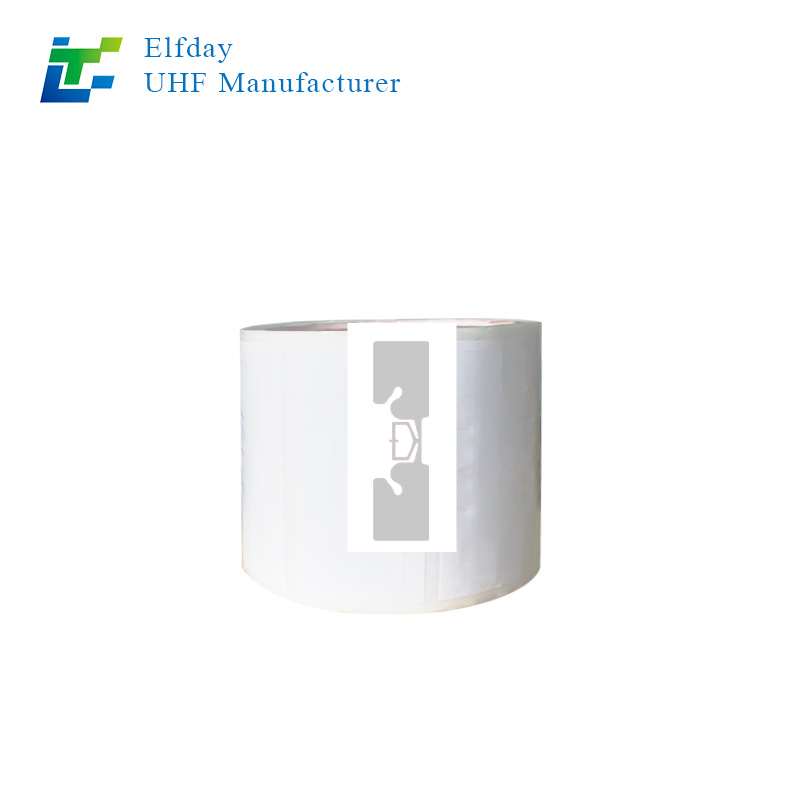
The glass material itself is generally compatible with RFID, but the shape of the surface can affect tag installation and antenna behavior.
A flat glass panel provides a different mounting condition from a narrow cylindrical bottle.
When an RFID label is wrapped around a curved surface, the antenna can change orientation and geometry.
This can influence reading performance depending on the tag design.
For cylindrical glass products, consider:
-
Tag dimensions
-
Antenna geometry
-
Label flexibility
-
Tag orientation
-
Reader antenna position
-
Distance between tag and reader
A tag designed for flat packaging should therefore be tested before being used extensively on curved glass containers.
Can RFID Tags Be Embedded Into Glass?
RFID can potentially be integrated into certain glass products, although the practical approach depends on the manufacturing process and application.
Instead of placing an RFID label on the exterior, the RFID component can be incorporated into or positioned within a product structure.
Potential benefits include:
-
Reduced risk of accidental removal
-
Better physical protection
-
Cleaner product appearance
-
Long-term identification
-
Improved durability in some applications
However, embedding an RFID tag changes the distance and materials surrounding the antenna.
The tag therefore needs to be designed and tested specifically for the final product.
RFID Tags on Glass vs. Metal
Glass and metal create very different conditions for RFID.
| Factor | Glass | Metal |
|---|---|---|
| Material type | Non-conductive | Conductive |
| Standard RFID tag | Often suitable | May perform poorly |
| Special tag required | Usually not for glass itself | Often required |
| Direct attachment | Generally possible | Requires careful tag selection |
| Liquid contents | Can affect performance | Can add complexity |
| Antenna placement | Important | Very important |
A standard RFID label that works well on glass should not automatically be expected to perform the same way on a metal surface.
Does Glass Affect RFID Read Range?
Glass itself generally has less impact on RFID read range than metal, but the complete application can still affect reading distance.
RFID read range depends on multiple factors:
-
RFID frequency
-
Tag antenna design
-
Reader power
-
Reader antenna
-
Tag orientation
-
Tag size
-
Distance
-
Product material
-
Contents of the container
-
Environmental conditions
This means there is no universal read distance for an RFID tag placed on glass.
For example, a tag on an empty glass container may perform differently from the same tag on a glass container filled with liquid.
Does Glass Thickness Affect RFID Performance?
Glass thickness can be a consideration, but it should not be treated as the only variable.
A tag mounted on a thin glass surface may have different conditions from one embedded behind a thicker glass structure.
The surrounding environment also matters.
For example:
RFID tag + thin glass + air
is a different configuration from:
RFID tag + thick glass + liquid + packaging
The most reliable way to evaluate the effect is to test the actual glass product under real operating conditions.
Does Glass Color Affect RFID?
Ordinary glass color is generally not the primary factor affecting RFID communication.
RFID uses radio-frequency signals rather than visible light, so transparent, tinted, or darker glass does not create the same optical limitations associated with barcode scanning.
However, specialized glass may contain coatings, conductive layers, or other materials that can change RF behavior.
If the glass product has a special coating or structure, it should be included in RFID testing.
Can RFID Tags Be Used on Glass Windows?
Yes, RFID tags can be attached to glass windows and other flat glass surfaces.
Potential applications include:
-
Asset identification
-
Equipment identification
-
Building components
-
Maintenance records
-
Installation tracking
-
Inventory management
However, if the glass contains a conductive coating or is installed near metal structures, the surrounding environment may affect RFID performance.
The tag should therefore be evaluated after installation rather than only on a standalone piece of glass.
Can RFID Tags Be Used on Glass Containers?
Yes.
Glass containers can be useful RFID applications because they are often:
-
Reusable
-
Individually identifiable
-
Moved through supply chains
-
Stored in warehouses
-
Used for controlled products
RFID can provide each container with a unique digital identity.
A simple workflow might look like:
Glass container
↓
RFID tag applied
↓
Unique identifier assigned
↓
Container enters production or storage
↓
RFID reader detects the tag
↓
System records the event
This can reduce the need for manual identification.
How Do You Choose an RFID Tag for Glass?
The right RFID tag depends on the complete application.
Consider the following factors.
1. Glass Shape
Is the surface:
-
Flat?
-
Cylindrical?
-
Curved?
-
Irregular?
2. Product Contents
Does the glass container hold:
-
Air?
-
Dry goods?
-
Liquid?
-
Chemical products?
-
Other dense materials?
3. Required Read Range
Determine how far away the reader needs to identify the tag.
4. Tag Orientation
Consider whether the tag will remain in a fixed position or rotate during handling.
5. Environmental Conditions
Determine whether the tag will experience:
-
Water
-
Heat
-
Cold
-
Chemicals
-
Washing
-
Outdoor exposure
-
Repeated handling
6. Mounting Method
Decide whether the tag will be:
-
Adhesive-mounted
-
Mechanically attached
-
Embedded
-
Encapsulated
How to Improve RFID Performance on Glass
If an RFID tag does not provide consistent reads on a glass product, several variables can be adjusted.
Change the Tag Position
Try moving the tag to another location on the glass.
For liquid-filled containers, changing the position relative to the liquid may make a difference.
Test Different Tag Orientations
Rotate the tag and evaluate reading performance at different angles.
Adjust Reader Antenna Placement
The reader antenna may need to be repositioned to create better coverage of the tagging area.
Select a Different Tag Design
Different RFID antenna designs can behave differently on curved surfaces and in the presence of liquids.
Increase the Separation From the Liquid
Where the product design allows it, increasing the distance between the RFID antenna and liquid can improve performance.
Test the Finished Product
Always test the RFID tag on the actual glass product rather than relying solely on tests performed with an empty container.
Glass RFID Applications
RFID tags on glass can be used in a variety of industries.
Food and Beverage
Glass bottles and jars can be identified for:
-
Inventory management
-
Production tracking
-
Distribution
-
Returnable packaging
Cosmetics
Glass containers can carry RFID tags for product identification and inventory workflows.
Healthcare and Laboratories
RFID can be used to identify suitable glass containers, laboratory assets, and other tagged items.
Manufacturing
Glass components and reusable containers can be assigned RFID identities for production and asset tracking.
Logistics
Reusable glass containers can be tracked as they move between facilities.
RFID Tags on Glass vs. Barcode Labels
RFID and barcodes use different identification methods.
| Feature | RFID | Barcode |
|---|---|---|
| Direct line of sight | Usually not required | Generally required |
| Multiple-item reading | Possible | Usually individual |
| Reading through packaging | Often possible | Limited |
| Orientation flexibility | Generally higher | More limited |
| Optical visibility | Not required | Required |
| Material considerations | RF environment | Optical visibility |
For glass products, RFID can be useful when items need to be identified automatically without requiring a scanner to visually locate each barcode.
Common Mistakes When Using RFID on Glass
Assuming Glass Guarantees Long Read Range
Glass is generally RFID-friendly, but read range still depends on the complete RFID system.
Ignoring Liquid Contents
This is one of the most common considerations for RFID-tagged glass bottles and containers.
Using a Flat-Product Tag on a Curved Surface Without Testing
The tag's antenna can behave differently when it is bent around a cylindrical or curved product.
Testing Only Empty Containers
An empty glass bottle may produce different results from a filled bottle.
Ignoring Reader Antenna Position
A good RFID tag cannot compensate for an unsuitable reader configuration.
FAQs
Can RFID tags be used on glass?
Yes. RFID tags can generally be attached to glass products, bottles, containers, windows, and other glass surfaces.
Can RFID tags be attached directly to glass?
Yes. Adhesive RFID labels can often be applied directly to glass. For demanding applications, durable or mechanically mounted RFID tags may be more appropriate.
Can RFID work through glass?
Yes. RFID signals can generally communicate through ordinary glass. However, the materials and contents behind the glass can affect performance.
Can RFID tags be used on glass bottles?
Yes. Glass bottles are suitable for many RFID applications. However, liquids inside the bottle can affect RF performance, particularly for UHF RFID.
Does glass block RFID signals?
Ordinary glass generally does not block RFID signals in the same way that metal can. Special coatings or surrounding materials may change this.
Can RFID tags be embedded in glass?
RFID components can potentially be integrated into certain glass products, depending on the manufacturing method and design. The final configuration should be tested for reliable communication.
Does curved glass affect RFID tags?
The curved surface can affect how the tag antenna is positioned and may influence performance. Tag design and orientation should be tested on the actual glass product.
What is the best place to put an RFID tag on a glass bottle?
There is no universal best position. The ideal location depends on the bottle shape, contents, tag design, reader antenna, orientation, and required reading distance.
RFID tags can be used on glass, and glass is generally a suitable material for RFID tagging.
Glass bottles, jars, containers, windows, and other glass products can carry RFID tags for identification, inventory management, logistics, production tracking, and asset management.
The key point is that glass itself is usually not the main limitation.
The contents of a glass container, especially liquids, can have a much greater effect on RFID performance. Curved surfaces, tag orientation, reader antenna placement, tag design, and required read distance should also be considered.
For the most reliable results, test the RFID tag on the actual glass product, with its actual contents, in its actual operating environment.
This helps ensure that the selected tag and reader configuration provide consistent identification rather than simply performing well in a controlled test.