




How do RFID systems handle duplicate read data?
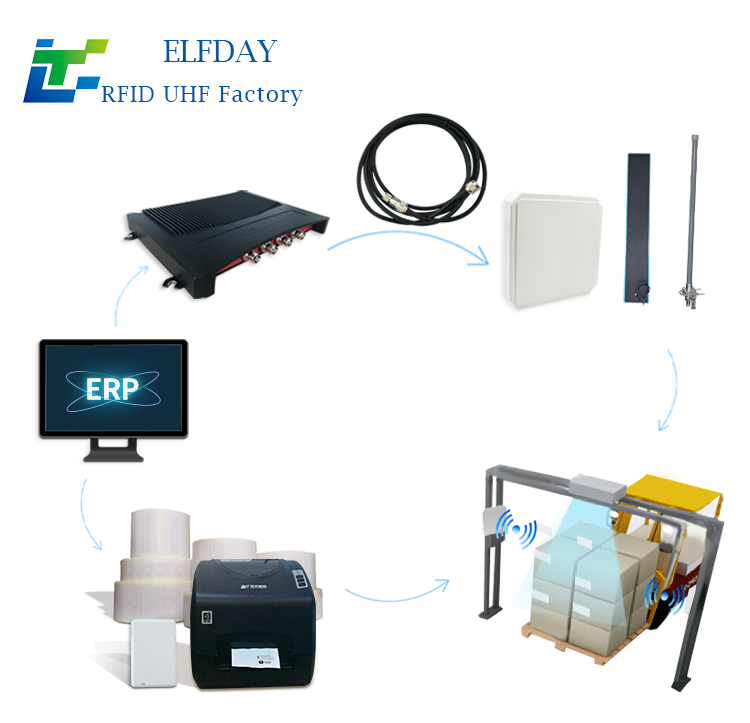
RFID systems handle duplicate read data through a process called RFID data filtering and deduplication. Because RFID readers can detect the same tag multiple times within a short period, the system filters repeated readings before sending the processed data to inventory management software.
This prevents duplicate records, inaccurate inventory counts, and misleading movement reports.
Why Does Duplicate RFID Read Data Occur?
Duplicate reads are common in RFID environments because readers continuously transmit radio signals and detect tags within their reading range.
Typical causes include:
Repeated scanning: A reader detects the same RFID tag multiple times during one scanning session.
Overlapping coverage: Multiple RFID antennas or readers detect the same tag simultaneously.
Extended reading range: A tag remains within the reader's detection area for an extended period.
Tag movement: A moving item passes through multiple RFID detection zones.
Multiple reading attempts: Readers repeatedly capture the same tag to improve identification reliability.
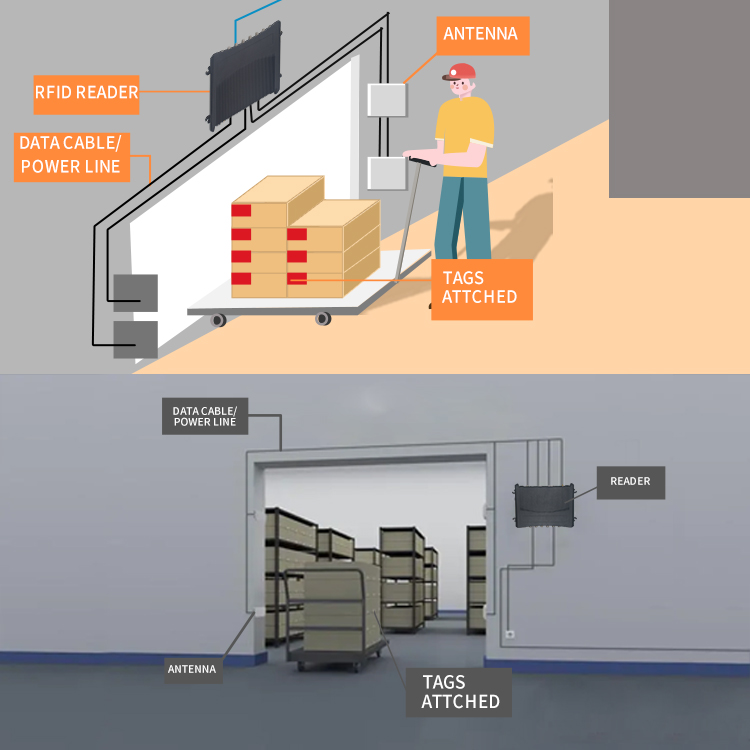
For example, when a product passes through a warehouse RFID portal, the reader might capture its tag ID 20 times within a few seconds.
Without data filtering, the inventory system could mistakenly interpret these readings as 20 separate items.
How RFID Systems Remove Duplicate Read Data
Most RFID systems use several data-processing techniques to eliminate duplicate readings.
Step 1: Collect Raw RFID Data
RFID readers collect tag IDs, timestamps, antenna information, and reader identifiers.
Step 2: Apply Time-Based Filtering
The software checks whether the same tag has already been detected within a predefined time window.
For example, if the same tag is read repeatedly within two seconds, the system may treat those readings as one detection event.
Step 3: Identify Duplicate Tag IDs
The middleware compares tag identification numbers and removes redundant records according to predefined rules.
Step 4: Combine Data from Multiple Readers
When several readers detect the same tag, the system can consolidate their readings into one logical event while retaining useful information about the detection location and time.
Step 5: Send Processed Data to the Inventory Database
After filtering, the system sends the relevant tag information to inventory management software for stock updates, tracking, and reporting.

Common RFID Duplicate Data Filtering Methods
|
Filtering method |
How it works |
Main benefit |
|
Time-based filtering |
Ignores repeated reads within a defined time interval. |
Reduces repeated records. |
|
Tag ID deduplication |
Identifies identical RFID tag IDs and removes redundant entries. |
Prevents duplicate inventory counting. |
|
Reader-based filtering |
Evaluates readings from different readers and antennas. |
Reduces overlapping detection records. |
|
Event-based filtering |
Groups multiple reads into one business event, such as receiving or shipping. |
Improves transaction accuracy. |
|
Middleware filtering |
Processes raw RFID data before transferring it to business applications. |
Reduces unnecessary database updates. |
Practical Example: Duplicate RFID Reads in a Warehouse
Suppose a warehouse uses an RFID portal to track products entering a storage area.
One product has the RFID tag ID E200001234567890.
During a single passage, the reader captures the same tag five times.
Raw RFID reader data
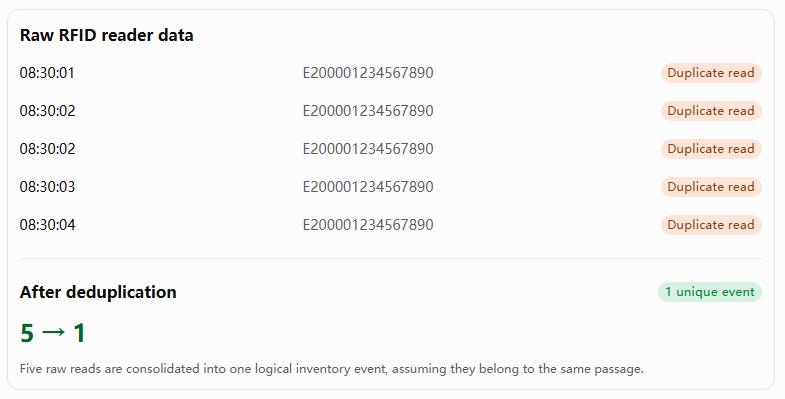
As a result, the inventory system records one product movement instead of five separate movements.
Best Practices for Preventing RFID Duplicate Data
Businesses can improve RFID data accuracy through several measures:
-
Configure appropriate filtering intervals: Set time windows based on tag movement speed and reader configuration.
-
Use RFID middleware: Process and filter raw reader data before transferring it to enterprise applications.
-
Optimize antenna placement: Reduce unnecessary overlapping coverage between RFID reading zones.
-
Implement event-based processing: Distinguish between individual tag reads and actual inventory transactions.
-
Maintain unique tag identification: Assign unique identifiers to individual inventory items.
-
Use database validation: Apply transaction IDs, event identifiers, and appropriate uniqueness constraints to prevent duplicate business records.
An important distinction: RFID deduplication should not simply delete every repeated tag ID. The same item may legitimately be read at different locations or during different inventory transactions. A reliable system considers the tag ID, timestamp, reader location, and business event before deciding whether two readings represent duplicates.
RFID systems handle duplicate read data through time-based filtering, tag ID deduplication, reader coordination, and event-based data processing. RFID middleware plays an important role by converting large volumes of raw tag readings into meaningful inventory events.
By implementing effective deduplication strategies, businesses can reduce inaccurate inventory counts, improve tracking reliability, and maintain more consistent warehouse management records.
.webp)
