




What Are the Functions of RFID System Software? From Data Collection to Business Management
An RFID system does more than identify tagged objects. It also needs software to collect identification data, process tag readings, manage inventory information, track asset movements, and connect RFID events with business operations.
RFID hardware, including tags, readers, and antennas, provides the foundation for automatic identification. However, without suitable software, the collected information may remain scattered, repetitive, or difficult to use.
RFID system software connects hardware devices with business applications. It transforms raw tag readings into organized information that companies can use for inventory management, logistics tracking, production monitoring, and asset management.
So, what are the main functions of RFID system software? How does it process data, and how can it support business management?
This article explores the key functions of RFID software, from data collection and processing to reporting and enterprise system integration.
RFID Data Collection: Capturing Information from RFID Readers
Data collection is one of the most fundamental functions of RFID system software.
When an RFID reader identifies a tag, it sends the collected information to the software platform through a supported communication interface.
Depending on the reader and system configuration, the information may include:
-
RFID tag identifier or EPC
-
Reader identification
-
Antenna port information
-
Read timestamp
-
Signal strength or other available read parameters
The software receives these observations and organizes them for further processing.
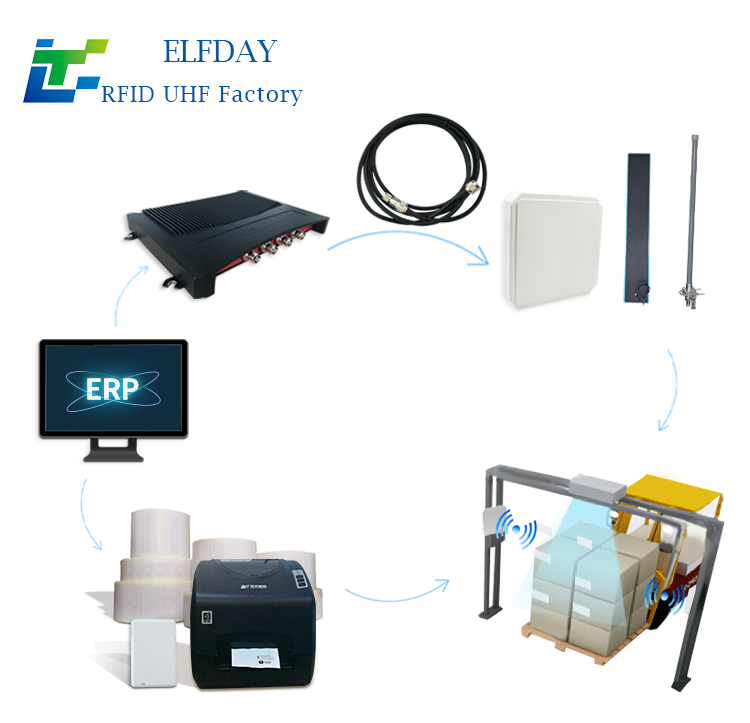
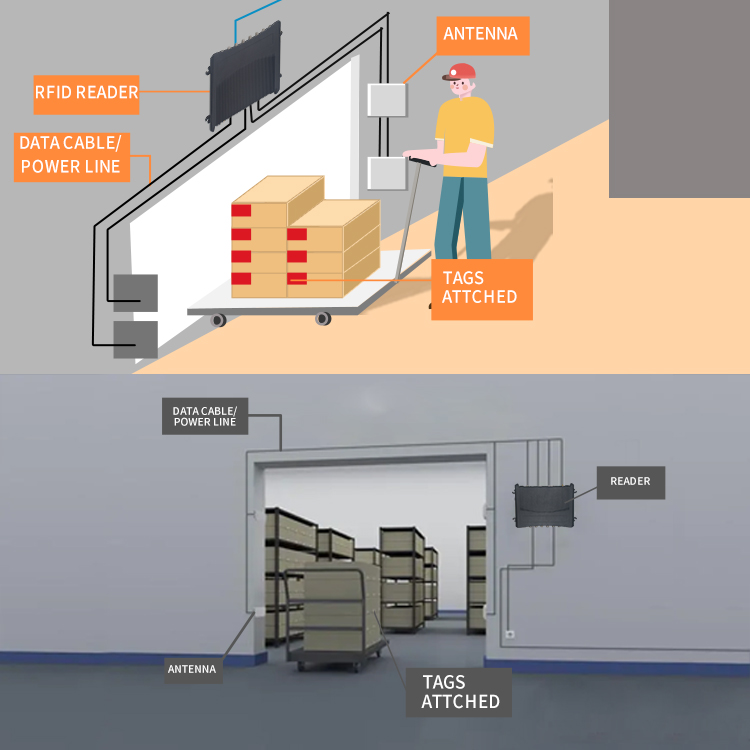
For example, in a warehouse, RFID readers may be installed at receiving areas, storage locations, and shipping checkpoints. When tagged cartons pass through these areas, the software receives identification events from the connected readers.
This provides the basic data needed for inventory updates and movement tracking.
RFID Data Filtering and Processing: Turning Raw Reads into Useful Events
RFID readers may identify the same tag multiple times while it remains within a reading area. When many tags and readers operate simultaneously, the resulting data can contain repeated observations.
RFID software helps process these readings before they enter business records.
Duplicate Read Filtering
The software can identify repeated observations of the same tag and apply configured filtering rules.
For example, multiple reads of one carton within a short period may be grouped or treated as one identification event, depending on the application.
Data Aggregation
The platform can combine related observations based on time, reader location, antenna port, or other configured parameters.
This helps organize large volumes of RFID data into a more manageable format.
Data Validation
Software can check whether detected identifiers match expected records or predefined business rules.
For example, a warehouse receiving system can compare detected EPCs with an expected delivery list.
Exception Detection
When the system identifies unexpected tags, missing identifiers, or unusual reading patterns, it can flag them for further investigation.
The filtering rules should be designed carefully. Excessive filtering may remove useful observations, while insufficient filtering may create unnecessary records.
RFID Inventory Management: Improving Stock Visibility
Inventory management is one of the most common applications of RFID system software.
By connecting RFID identification data with inventory records, businesses can improve visibility into the items recorded within their operations.
Typical inventory management functions include:
-
Item identification
-
Inventory record lookup
-
Receiving and dispatch records
-
Stock status updates
-
Inventory counting
-
Missing or unexpected item notifications
-
Inventory history management
For example, when tagged products are identified at a warehouse receiving station, the software can compare their identifiers with purchase orders or expected delivery records.
After the receiving process is validated, the system can update the corresponding inventory records.
RFID-Assisted Inventory Counting
Traditional inventory counting often requires employees to scan individual barcodes.
An RFID-based process can identify multiple compatible tags within a reader's communication area without requiring direct line-of-sight scanning.
The software collects the detected identifiers and compares them with the expected inventory list.
This helps employees identify discrepancies and review inventory records more efficiently.
However, a tag not detected during a particular scan should not automatically be considered lost. Reading conditions, tag placement, and system configuration may affect identification results.
Real-Time Asset Tracking and Movement Management
RFID software can record identification events from different reading locations and use them to manage asset movement.
This is particularly useful for businesses that need to track tools, equipment, reusable containers, pallets, and other valuable assets.
Common functions include:
-
Recording asset identification events
-
Associating tags with asset records
-
Tracking movement between designated checkpoints
-
Maintaining movement history
-
Displaying the last recorded reading location
-
Flagging unexpected identification events
For example, a manufacturing company may install RFID readers at equipment storage areas and selected production checkpoints.
When an RFID-tagged tool is identified at a checkpoint, the software records the event and associates it with the corresponding tool record.
By reviewing these records, managers can understand where an asset was last detected and examine its movement history.
It is important to distinguish between checkpoint-based tracking and continuous real-time positioning. A conventional RFID reader records tag observations within its communication area; it does not necessarily provide continuous location coordinates.
RFID Production Management: Supporting Manufacturing Processes
RFID system software can also support production tracking by connecting tagged workpieces, components, or carriers with manufacturing records.
In a production environment, RFID identification events can be associated with production orders, workstations, and process stages.
Possible functions include:
Work-in-Process Identification
RFID tags can identify workpieces or carriers as they move through production operations.
Production Stage Recording
When a tagged item is detected at a designated workstation, the software can record the corresponding identification event.
Process Information Lookup
The system can retrieve information associated with the tag, such as product type, production order, or recorded process status.
Production Exception Management
Software can compare detected items with expected production sequences and flag discrepancies for review.
For example, if a workpiece is detected at a station where it is not expected, the system can generate an exception according to configured production rules.
RFID software supports production visibility, but process completion and quality approval should be confirmed through the appropriate manufacturing controls.
RFID Access Control and Personnel Identification

RFID software can manage identification information for access control applications.
When an authorized RFID card or credential is presented to a compatible reader, the system can retrieve the associated user record and evaluate access permissions.
Common software functions include:
-
Credential registration
-
User information management
-
Access permission configuration
-
Access event recording
-
Entry and exit history
-
Unauthorized access alerts
-
Time-based access rules
For example, an enterprise can assign RFID credentials to employees and configure access permissions for different areas.
When a credential is presented at an access point, the access control software checks the relevant permissions and communicates the result to the connected control equipment.
Actual access decisions depend on the credential technology, reader configuration, controller, and security policy.
RFID Reporting and Data Analysis
RFID software can convert identification records into reports that help businesses understand operational activity.
Instead of reviewing individual tag readings, managers can analyze organized information according to business requirements.
Common reporting functions include:
-
Inventory summaries
-
Asset movement reports
-
Receiving and shipping records
-
Production tracking reports
-
Reader activity reports
-
Exception reports
-
Historical identification records
For example, a warehouse manager may use RFID software to review which tagged cartons were detected during a receiving period, identify discrepancies, and compare recorded activity across different checkpoints.
Reports can help businesses identify operational issues and evaluate whether their RFID processes are working as expected.
The usefulness of reporting depends on data quality, correct event processing, and suitable report definitions.
RFID Device Management and System Configuration
Some RFID software platforms also provide centralized management of connected hardware.
Depending on the platform and reader capabilities, these functions may include:
-
Reader registration
-
Device status monitoring
-
Network configuration
-
Reader parameter management
-
Antenna configuration
-
Firmware or software maintenance
-
Device error notifications
-
Connection status monitoring
For businesses operating multiple RFID readers, centralized device management can simplify maintenance and system administration.
For example, an enterprise with RFID reading points across several warehouse areas may use a management platform to monitor reader connectivity and review device status.
Not all RFID applications require centralized device management. The required functions depend on the number of readers, system architecture, and maintenance strategy.
Integration with ERP, WMS, MES, and Other Business Systems
One of the most valuable functions of RFID system software is its ability to connect identification data with existing business applications.
RFID readers collect tag information, but enterprise applications provide the broader business context.
Common integration targets include:
ERP Systems
Enterprise Resource Planning (ERP) systems manage business information such as products, purchasing, orders, and financial records.
RFID data can help update or verify relevant operational records, depending on the integration design.
WMS Systems
Warehouse Management Systems (WMS) manage receiving, storage, picking, inventory, and shipping processes.
RFID software can send validated identification events to a WMS to support warehouse operations.
MES Systems
Manufacturing Execution Systems (MES) manage production activities, work orders, and manufacturing process records.
RFID identification events can help associate workpieces and carriers with the correct production information.
Asset Management Systems
RFID software can exchange identification and movement records with asset management platforms.
This helps organizations maintain more consistent asset information across departments.
Common Integration Methods
Depending on the equipment and software architecture, integration may use:
-
REST APIs
-
SDKs
-
Database interfaces
-
Middleware
-
Message queues
-
TCP/IP communication
-
Industrial communication protocols
Before implementation, businesses should confirm the supported interfaces, data formats, authentication requirements, and transaction rules.
User Permissions, Data Security, and System Maintenance
RFID software may process sensitive operational information, including inventory records, asset movements, employee credentials, and production data.
For this reason, access control and data protection should be considered during system design.
Common management functions include:
User Role Management: Assign different permissions to administrators, warehouse operators, managers, and other users.
Operation Logs: Record important system activities to support auditing and troubleshooting.
Data Backup: Maintain backup procedures for important business records and configuration information.
Data Retention: Define how long identification events and historical records should be stored.
Communication Security: Apply suitable network protection and authentication mechanisms to connections between readers, servers, and business applications.
The exact security capabilities depend on the software platform and deployment architecture.
How to Choose RFID System Software
Different RFID projects have different software requirements. A simple inventory application may only need tag identification and stock management, while a large industrial deployment may require device management, production integration, and advanced reporting.
Before selecting RFID software, consider the following factors.
1. Application Requirements
Identify the primary purpose of the system, such as inventory management, asset tracking, logistics, production monitoring, or access control.
2. Hardware Compatibility
Confirm that the software supports the RFID readers, communication interfaces, and tag technologies used in the project.
3. Data Processing Capabilities
Evaluate whether the platform supports duplicate filtering, data aggregation, event validation, and exception handling.
4. Integration Requirements
Check whether the software can connect with the company's existing ERP, WMS, MES, or asset management systems.
5. Reporting and Analytics
Determine whether the platform provides the reports and historical information needed by operational teams and managers.
6. Scalability
Consider whether the software can support additional readers, tags, users, locations, and business processes as the project expands.
7. Security and Maintenance
Review user permissions, logging, backup procedures, update policies, and technical support arrangements.
A suitable RFID software platform should match the actual business workflow rather than simply offer the largest number of features.
RFID system software plays an important role in transforming tag identification data into useful business information.
Its functions can include data collection, duplicate filtering, inventory management, asset tracking, production monitoring, access control, reporting, device management, and integration with enterprise applications.
While RFID tags, readers, and antennas provide the hardware foundation, software determines how identification events are organized, interpreted, and applied to business operations.
By selecting software that matches the application requirements and integrates with existing systems, businesses can build a more connected and manageable RFID solution.
EFLDAY provides RFID-related hardware, including RFID tags, readers, antennas, and printers, for applications such as inventory management, logistics, manufacturing, and asset identification. Selecting compatible hardware and software is an important step in building an effective RFID system.
Frequently Asked Questions
1. What does RFID system software do?
RFID system software collects data from RFID readers, processes tag identification events, manages inventory and asset records, generates reports, and exchanges information with business applications.
2. Is RFID software required for every RFID system?
Not necessarily. A basic RFID setup may communicate directly with a computer or controller using reader software or an SDK. More advanced applications generally require software for data processing, business rules, reporting, and system integration.
3. What is the difference between RFID middleware and RFID management software?
RFID middleware mainly handles communication between readers and business applications, including data filtering, aggregation, and event processing. RFID management software may provide broader functions such as inventory management, asset tracking, reporting, user permissions, and operational workflows.
4. Can RFID software connect to an ERP or WMS?
Yes. RFID software can integrate with ERP, WMS, MES, and other business systems through APIs, middleware, database interfaces, or supported communication methods. The available integration options depend on the software and hardware architecture.
5. Can RFID software provide real-time inventory information?
It can provide inventory information based on identification events received from connected readers. The accuracy and freshness of the information depend on reader coverage, tag readability, event processing rules, network connectivity, and inventory update procedures.
6. Does RFID software support multiple RFID readers?
Many RFID software platforms can manage multiple readers and identification points. Before deployment, confirm the platform's supported device models, connection limits, communication interfaces, and centralized management capabilities.

