



How Can RFID Tags Maintain Consistent Performance During Item Movement?
RFID technology enables businesses to identify and track items without scanning each tag individually. In applications such as conveyor systems, warehouse operations, logistics, manufacturing, and vehicle tracking, however, tagged items are often moving when identification takes place.
Movement introduces additional challenges. A tag may pass through a reading zone at an unfavorable angle, remain within the effective coverage area for only a short time, or experience changing radio-frequency conditions as its surroundings change. These factors can cause inconsistent identification results if the RFID system is not designed for dynamic operation.
Maintaining consistent RFID tag performance during item movement requires the right combination of tag selection, mounting methods, reader configuration, antenna placement, and real-world testing.
1. Understand How Movement Affects RFID Reading
An RFID system identifies a tag when the tag receives sufficient RF energy and communicates successfully with a compatible reader. During movement, the conditions for communication can change continuously.
For example, a box moving along a conveyor may enter the reading zone with its tag facing the antenna, then rotate as it travels. A metal component may pass through areas with different RF reflections. A fast-moving package may leave the reading zone before the reader has successfully identified its tag.
Common factors affecting moving-item identification include:
-
Item speed and the time available for reading
-
Tag orientation relative to the reader antenna
-
Distance between the tag and antenna
-
Changes in the item's position or rotation
-
Materials near the tag, including metal and liquids
-
Antenna coverage and reader configuration
-
Interference from nearby RFID equipment or other RF sources
These factors interact. Increasing reader power, for example, may help energize some tags at greater distances, but it does not automatically solve poor tag orientation, unsuitable tag construction, or inadequate coverage.
The first step is to identify the actual movement conditions and determine where inconsistent reads occur.
2. Select RFID Tags for the Application
Tag selection is essential when items are identified while moving. The tag must be compatible with the reader and suitable for the item's material, size, operating environment, and tracking requirements.
Choose the appropriate frequency
UHF RFID is commonly used for logistics, warehouse automation, conveyor systems, and applications that require identification from a distance or the reading of multiple items. HF RFID and NFC are used in applications where their specific communication characteristics, operating distance, and device compatibility are appropriate.
The best frequency depends on the required reading distance, application workflow, tag design, and local operating requirements.
Match the tag to the item
The material to which a tag is attached can affect its performance. Conventional RFID tags may perform poorly when mounted directly on metal. Liquids and other materials can also influence RF propagation.
For metal equipment, containers, tools, or components, an appropriately designed anti-metal RFID tag may be necessary. For cartons or general packaging, a conventional label or inlay may be suitable, depending on the application.
Consider physical durability
Moving items may experience vibration, friction, impacts, repeated handling, moisture, dust, or temperature changes. The tag construction and attachment method should withstand the actual conditions.
A tag that becomes detached, damaged, or incorrectly positioned during operation can cause identification failures even when the reader and antenna are configured correctly.
Before choosing a tag for high-speed or continuous movement, evaluate it using representative items and operating conditions rather than relying only on its general product category.
3. Standardize Tag Placement and Orientation
Consistent tag placement makes RFID performance more predictable.
When tags are attached randomly, their distance and orientation relative to the antenna may vary significantly. Some tags may be easy to read, while others may enter the reading zone in less favorable positions.
Where the workflow allows it, establish a standard mounting position for each item type.
Useful practices include:
-
Place tags in a consistent location on similar items.
-
Avoid mounting tags where nearby metal or liquid could significantly affect performance unless the tag is designed for that application.
-
Use a suitable attachment method to prevent tags from shifting during movement.
-
Test different tag orientations when items can rotate or tilt.
-
Confirm that labels, packaging, or protective covers do not interfere with the intended tag design.
For items that move in unpredictable orientations, tag placement may need to be combined with a suitable antenna arrangement or a tag designed for the required installation.
Multiple tags on one item may be appropriate in some specialized applications, but this increases hardware and data-management complexity. Test whether improved coverage justifies the additional cost before adopting that approach.
4. Optimize Antenna Placement and Reading-Zone Coverage
Antenna placement is especially important when items pass through a defined reading zone.
The antenna must provide sufficient coverage for the tag to communicate while allowing the system to distinguish the intended items from nearby objects.
The appropriate configuration depends on the physical layout.
Conveyor systems
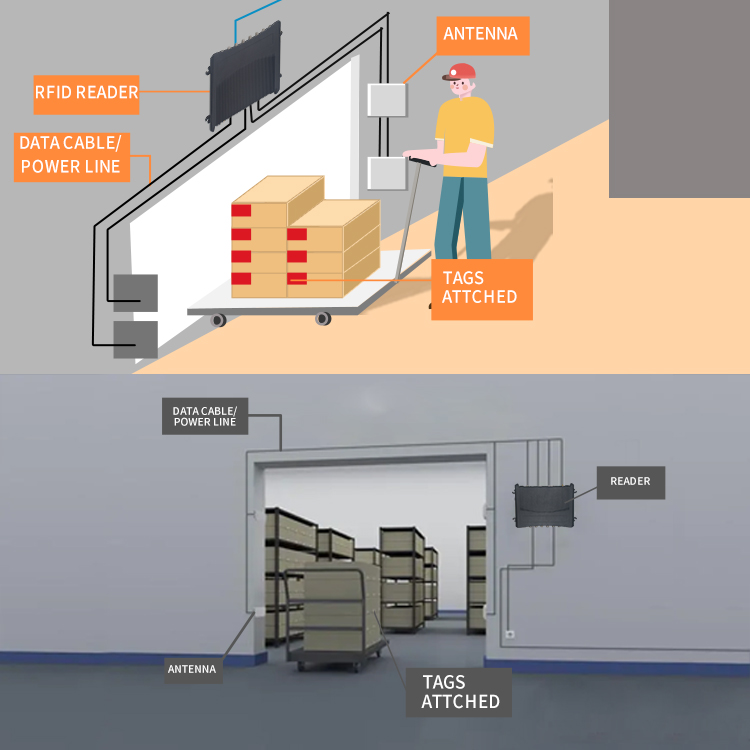
Position antennas to cover the intended conveyor path. Consider the width and height of the items, their movement speed, and the locations where tags are mounted. If items can rotate, a single antenna angle may not provide consistent coverage.
Warehouse portals
A portal may require antennas positioned on different sides or at different heights to accommodate varied item sizes and tag orientations. The goal is to identify items passing through the intended zone without unnecessarily reading tags in adjacent areas.
Manufacturing workstations
For items moving between production stages, define the reading area around the actual transition point. Antenna positioning should support the intended event, such as a component entering a workstation or a container leaving a process area.
Circularly polarized antennas can help accommodate varying tag orientations, while linearly polarized antennas may perform well when tag orientation is controlled. Neither option is universally superior; the choice depends on the tag antenna, installation geometry, and RF environment.
Adding antennas without considering their coverage and coordination can introduce interference or unwanted reads. Evaluate the complete antenna arrangement under real operating conditions.
5. Match Reader Settings to Item Speed
A moving tag has a limited amount of time to communicate while it remains in the effective reading zone. Reader settings should therefore be selected for the application's movement speed and identification requirements.
Important considerations include:
Transmit power: Appropriate power can help the reader energize tags across the intended zone. Excessive power may increase unwanted reads or expand coverage beyond the desired area. Settings must also comply with applicable RF regulations.
Inventory parameters: Compatible readers may provide configurable inventory settings that affect how tags are inventoried. Suitable settings depend on the tag population, movement conditions, reader capabilities, and required identification time.
Reader operating mode: Some applications benefit from continuous inventory, while others are better served by event-triggered or zone-specific reading workflows. The right approach depends on when identification should occur.
Reader coordination: If multiple readers operate nearby, their activity may need to be coordinated to reduce interference and maintain reliable coverage.
Avoid optimizing settings based on a stationary test alone. A configuration that performs well with items at rest may not identify every required tag when items pass through quickly.

6. Account for Movement Speed and Reading Time
Item speed directly affects how long a tag remains in a reading zone.
A slowly moving item may be exposed to the reader's field for a relatively long period, allowing multiple communication attempts. A fast-moving item may have only a brief opportunity to be identified.
However, there is no single maximum speed that applies to every RFID system. Performance depends on the tag, reader, antenna geometry, tag orientation, RF environment, and required identification completeness.
To assess a moving application, consider:
-
The speed at which items travel
-
The length and shape of the effective reading zone
-
The spacing between consecutive items
-
The number of tags carried by each item
-
The time available before an item reaches the next process stage
-
Whether every tag must be identified in a single pass
If the available reading time is insufficient, possible changes include improving antenna coverage, adjusting the reading-zone layout, reducing item speed where operationally feasible, or changing tag placement.
These changes should be validated through testing because expanding a reading zone can also increase the risk of identifying items outside the intended area.
7. Manage RF Interference and Changing Surroundings
The radio-frequency environment can change as items move through a facility.
Metal racks, machinery, vehicle bodies, liquid-filled containers, and other structures may reflect or absorb RF energy. These effects can create areas where tag communication is more difficult.
Nearby RFID readers can also affect performance if their reading zones overlap or their operations are not properly coordinated.
To reduce these risks:
-
Test the system with the actual racks, machines, packaging, and surrounding materials in place.
-
Check for nearby readers and possible RF interference.
-
Adjust antenna position and reader power to improve coverage.
-
Consider suitable anti-metal tags when items have metal mounting surfaces.
-
Re-test after changes to the conveyor, storage layout, or equipment configuration.
RF shielding may help control the reading zone in certain applications, but it must be designed carefully. Shielding that blocks unwanted reads can also weaken the intended signal.
8. Separate RFID Reading Problems from Tracking-System Problems
Consistent tracking requires more than successful RF communication. The application must also process reader data correctly.
For example, a reader may identify a tag several times while an item remains in the reading zone. Software may need to consolidate repeated observations and determine whether the item has entered, exited, or passed through a particular location.
Potential problems include duplicate event records, delayed network transmission, incorrect zone assignments, and application rules that discard valid observations.
When investigating inconsistent tracking, distinguish between:
-
Tag communication: Did the reader successfully identify the tag?
-
Event detection: Did the system correctly determine the item's movement or transition?
-
Data processing: Was the identification event transmitted, stored, and displayed correctly?
This distinction helps prevent unnecessary hardware changes when the root cause is in the software or data-processing workflow.
9. Test RFID Performance Under Real Movement Conditions
A practical test is one of the most reliable ways to determine whether an RFID system can maintain consistent performance during item movement.
Testing should reproduce the intended application as closely as possible. Use the actual tag model, reader, antenna arrangement, item materials, and operating speed.
A useful test plan should include:
-
Define the expected items. Record the number and types of tags that should be identified during each pass.
-
Set the movement conditions. Test representative speeds, item spacing, and travel paths.
-
Vary tag orientation. Include realistic differences in how tags face the antennas.
-
Test the actual environment. Include packaging, metal structures, machinery, and nearby equipment.
-
Repeat each scenario. Multiple trials help reveal intermittent failures.
-
Record the results. Compare the expected tags with the unique tags successfully identified.
-
Adjust one variable at a time. Change tag placement, antenna position, or reader settings systematically to understand the effect.
Useful performance indicators include read completeness, missed-tag frequency, identification time, throughput, and unwanted reads from outside the intended zone.
A simple read-completeness calculation is:
Read completeness = Unique expected tags identified ÷ Total expected tags × 100%
For example, if 98 of 100 expected tags are identified during a defined test, the read completeness is 98%. This figure describes that specific test condition; it should not be treated as a guaranteed result for other speeds, layouts, or tag populations.
10. Maintain Performance After Deployment
RFID performance can change after installation as equipment, layouts, and operating conditions evolve.
A maintenance plan should include periodic checks of tag attachment, antenna positioning, reader settings, and system event processing. Re-test the reading zone after significant changes to conveyor speed, item packaging, storage arrangements, or nearby equipment.
It is also useful to monitor identification completeness over time. A gradual decline may indicate tag damage, shifting antenna positions, new sources of interference, or changes in the workflow.
Where possible, establish baseline measurements during commissioning. Comparing later results against that baseline makes it easier to identify meaningful changes and prioritize troubleshooting.
Maintaining consistent RFID tag performance during item movement requires a coordinated approach to tag selection, mounting, antenna coverage, reader configuration, RF interference management, and application-level data processing.
The most effective configuration depends on how items move, how tags are attached, and how quickly the system must identify them. No single tag type or reader setting can guarantee consistent performance across every environment.
By standardizing tag placement where possible, designing the reading zone around actual movement conditions, and testing the complete system under realistic workloads, businesses can improve identification consistency and build more dependable RFID tracking workflows.
Planning an RFID tracking application for moving items? Evaluate the tag, reader, antenna, item material, movement speed, and required read completeness together to identify a configuration that fits your operating environment.