



What Makes an RFID Tag Suitable for a Specific Application?
Not every RFID tag works equally well in every application. A tag that performs reliably on a cardboard box may struggle when attached to metal equipment, while a compact label designed for retail products may not withstand repeated industrial use.
An RFID tag is suitable when its technical characteristics match the object being tracked, the way it will be read, and the conditions it will encounter during operation.
Several factors determine this suitability, including RFID frequency, antenna design, tag size, mounting method, environmental resistance, and compatibility with the reader. Understanding these factors helps businesses choose tags that deliver reliable identification without paying for features they do not need.
1. The Application Determines the Required Tag Design
The first step in RFID selection is to define the task the tag must perform.
For example, a retailer may need to identify individual products during inventory counts. A warehouse may need to read multiple cartons as they pass through a receiving area. An industrial facility may need to track metal tools throughout their service life.
Although all three applications use RFID, their requirements are different.
Before selecting a tag, clarify:
-
What is being tracked? Products, packages, tools, machinery, containers, textiles, or other assets.
-
Where will the tag be installed? On cardboard, plastic, metal, glass, fabric, or another surface.
-
How will it be read? With a handheld reader, desktop device, fixed reader, or portal system.
-
What reading performance is required? Close-range identification, reliable item-level scanning, or automatic multi-tag reading.
-
How long must it last? A single shipping cycle, repeated reuse, or several years of service.
These details establish the requirements against which potential tag designs should be evaluated.
2. Material Compatibility Affects RFID Performance
The material carrying an RFID tag can influence how well the tag communicates with the reader. This is particularly important for applications involving metal, liquid, or unusual mounting surfaces.
Metal Assets
Metal can interfere with the antenna behavior of conventional RFID tags, especially in UHF applications. A standard label placed directly on a metal surface may experience reduced reading performance.
On-metal RFID tags use specialized antenna structures or other design features to support operation on conductive surfaces.
They may be suitable for machinery, tools, metal containers, equipment cabinets, and industrial fixtures.
Plastic, Paper, and Cardboard
Many standard RFID labels work well on paper packaging, cardboard cartons, and suitable plastic products.
These applications often prioritize compact dimensions, printing, encoding, cost, and reliable reading during inventory or logistics operations.
However, the contents of a package also matter. A label attached to an empty plastic container may perform differently from one attached to a container filled with liquid.
Glass, Fabric, and Curved Surfaces
Glass containers, textiles, and curved products can introduce additional installation constraints.
A suitable tag must fit the available space, remain securely attached, and maintain acceptable reading performance in its final position. Flexible labels or application-specific designs may be useful when rigid tags cannot fit the surface.
The key principle is to evaluate the tag on the actual object rather than assuming that a successful test on a different surface guarantees the same result.
3. RFID Frequency Must Match the Reading Task
RFID frequency influences the communication characteristics of the system and helps determine which tag designs are appropriate.
| RFID technology | Typical application considerations |
| LF RFID | Certain close-range identification and specialized tracking applications |
| HF RFID | Short-range identification, smart cards, and compatible NFC-related applications |
| UHF RFID | Inventory management, logistics, warehouse tracking, and efficient multi-tag reading |
The best choice depends on the reading distance, data exchange requirements, reader infrastructure, surrounding materials, and applicable regional frequency rules.
For example, an application that requires a user to tap a phone against a product may favor an NFC-compatible design. A warehouse that needs to identify many tagged cartons from a distance may be better suited to UHF RFID.
Frequency should therefore be selected as part of the complete system design, not as an isolated tag specification.
4. Read Range and Antenna Design Must Fit the Workflow
A tag's maximum advertised read range does not necessarily represent its performance in daily operation.
Actual reading performance depends on the tag antenna, chip sensitivity, reader power, reader antenna, tag orientation, mounting surface, surrounding objects, and the physical environment.
Consider two examples.
A retail worker may need to identify products on a particular shelf without unintentionally reading products in nearby aisles. In this case, a controlled reading zone may be more important than maximum range.
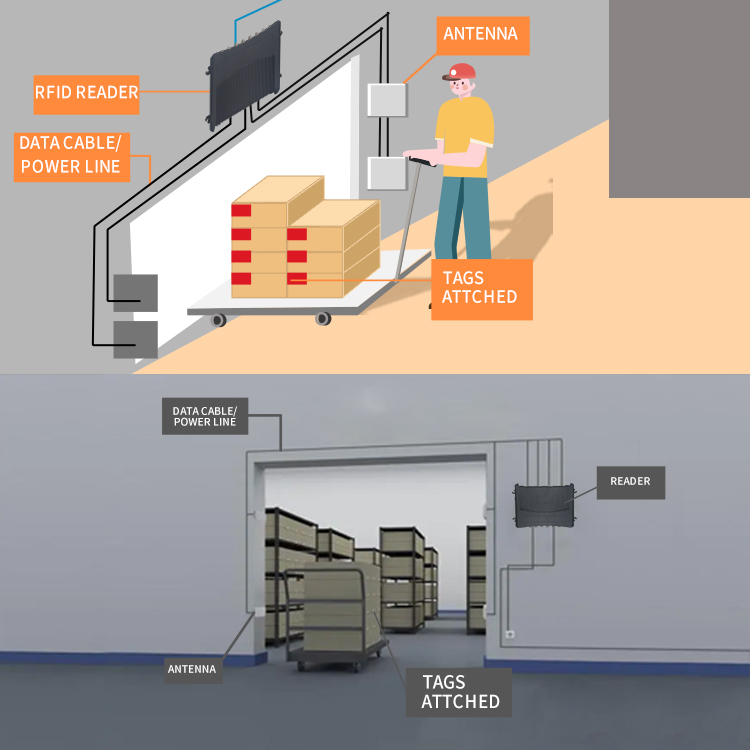
A warehouse portal may need to identify several tagged cartons as a pallet moves through a defined area. Here, read consistency, tag orientation, movement speed, and multi-tag performance become important.
When defining read requirements, specify:
-
The expected distance between tag and reader
-
The tag's likely orientation
-
Whether the item is stationary or moving
-
Whether one tag or multiple tags must be read
-
The area in which successful reading should occur
This gives the selection process a measurable target instead of relying on a single range figure.
5. Tag Size and Shape Must Fit the Object
An RFID tag must fit the item without interfering with its normal use.
Small products may require compact labels or miniature tags. Larger equipment may provide enough space for a more substantial antenna or protective housing.
Tag dimensions can also influence reading performance. A smaller tag is not automatically unsuitable, but limited antenna space may introduce trade-offs that need to be evaluated.
Consider the following:
-
Available mounting area
-
Surface curvature
-
Maximum permitted thickness
-
Visibility and appearance requirements
-
Clearance from nearby metal or other materials
-
Whether the tag needs to be hidden, embedded, or externally mounted
For products with limited space, testing several dimensions can help establish the best balance between physical fit and reading reliability.
6. Environmental Resistance Must Match Actual Conditions
Some RFID tags operate in relatively controlled indoor environments. Others must withstand outdoor weather, industrial cleaning, repeated handling, or elevated temperatures.
The required protection depends on the application's actual conditions.
Moisture and Outdoor Exposure
Outdoor tags may need suitable housing, sealing, UV resistance, and durable attachment. Water splashes, rain, immersion, and high-pressure washing are different exposure conditions and should not be treated as equivalent.
Temperature Changes
For applications involving heat or cold, verify the specified operating temperature, exposure duration, and thermal cycling requirements. Adhesives, chip connections, antennas, and protective housings may have different limitations.
Chemicals and Cleaning
A tag used in manufacturing or laundry operations may encounter detergents, disinfectants, oils, or industrial chemicals. Material compatibility should be assessed against the actual substances, concentrations, and exposure times.
Impact and Vibration
Tools, machinery, and reusable containers may need rugged housings, reinforced mounting points, or mechanically secure attachment methods.
A tag described as industrial-grade is not automatically suitable for every industrial environment. The complete construction must meet the conditions of the intended application.
7. The Mounting Method Is Part of Tag Suitability
Even a well-designed RFID tag can fail if it is installed incorrectly or attached with an unsuitable method.
Common mounting options include:
-
Adhesive backing for suitable flat surfaces
-
Screws or rivets for secure mechanical attachment
-
Cable ties for selected equipment and containers
-
Sewn-in or integrated designs for textiles
-
Embedded or molded-in structures for applications designed around permanent integration
The mounting method should match the surface material, tag construction, expected service life, and environmental exposure.
For example, an adhesive suitable for cardboard packaging may not remain secure on an oily metal surface or a plastic asset exposed to repeated temperature changes.
It is also important to test the tag in its final location. Moving a tag only a short distance can change its proximity to metal, liquid, or other objects and affect performance.
8. Chip and Data Requirements Should Match the System
RFID tags differ in their memory capabilities, identification features, and supported functions.
Some applications need only a unique identifier linked to a record in an inventory or asset management system. Others may require additional memory, specific data formats, locking features, or compatibility with an established encoding process.
Before choosing a tag, confirm:
-
What identifier or data must be stored
-
Whether the system uses a standard identifier format
-
Whether additional user memory is required
-
Whether tags must be locked or access-controlled
-
How tags will be encoded and verified
-
Whether the existing readers and software support the chosen tag
Storing more information directly on a tag is not always necessary. In many systems, a unique identifier linked to a database is sufficient and easier to manage.
The tag's chip, encoding process, and software integration should be selected together.
9. Cost and Service Life Must Be Considered Together
The cheapest tag is not always the most economical option.
A low-cost label may be ideal for a disposable shipping carton. For a reusable industrial asset, however, frequent replacement could cost more than using a durable tag from the beginning.
Compare the expected total cost, including:
-
Unit price
-
Installation labor
-
Encoding and verification
-
Reader compatibility
-
Replacement frequency
-
Maintenance requirements
-
Potential disruption caused by missed reads or lost tags
A suitable RFID tag provides the required performance and durability at a reasonable overall cost.
Avoid paying for unnecessary features, but do not compromise essential performance simply to reduce the initial purchase price.
10. How to Verify That an RFID Tag Is Suitable
Specifications help narrow down the options, but practical testing confirms whether a tag works in the intended application.
A structured evaluation can follow five steps.
Step 1: Define the requirements. Document the tracked item, surface material, reading workflow, required distance, environmental conditions, and expected service life.
Step 2: Select candidate designs. Compare suitable tag formats, frequencies, sizes, antenna designs, and mounting options.
Step 3: Test on actual assets. Install samples using the intended mounting method and read them with the planned RFID equipment.
Step 4: Reproduce operating conditions. Test realistic orientations, movement, surrounding materials, and any relevant temperature, moisture, chemical, or mechanical exposure.
Step 5: Record acceptance criteria. Evaluate read consistency, physical condition, attachment strength, and other requirements before approving the tag for wider deployment.
Where possible, test multiple samples of each candidate rather than relying on one successful reading. This helps reveal variation and makes comparisons more meaningful.
11. Common Mistakes When Selecting RFID Tags
Choosing by Read Range Alone
Maximum range does not guarantee reliable reading in the intended location. The tag, reader, antenna, mounting surface, and workflow must work together.
Ignoring the Asset Material
A tag that works well on cardboard may perform poorly on metal or near liquid. Always provide the actual mounting surface when evaluating candidates.
Overlooking Environmental Conditions
A tag suitable for ordinary indoor use may not withstand repeated washing, outdoor exposure, chemicals, or high temperatures.
Selecting a Tag That Does Not Fit
The tag must fit the available mounting space and remain compatible with the asset's shape, function, and handling requirements.
Skipping Real-World Testing
Catalog specifications cannot reproduce every installation or operating condition. Sample testing helps identify problems before large-scale deployment.
Frequently Asked Questions
What is the most important factor when choosing an RFID tag?
Start with the application: what is being tracked, where the tag will be installed, and how the reader must identify it. Material compatibility, read range, environmental resistance, mounting, and data requirements then help determine the suitable design.
Can the same RFID tag be used for different applications?
Sometimes. A tag may support multiple applications when the mounting surfaces, reading requirements, and operating conditions are sufficiently similar. However, suitability should be verified separately for each use case.
How do I know whether I need a custom RFID tag?
A standard tag may be sufficient if it meets the required dimensions, reading performance, environmental resistance, and mounting needs. A custom design may be worth evaluating when standard options cannot satisfy a critical requirement, such as an unusual shape, limited installation space, specialized mounting, or demanding operating conditions.
Does a more expensive RFID tag perform better?
Not necessarily. Price alone does not establish suitability. A more expensive tag may provide useful protection or specialized performance, but those features only add value when the application needs them.
Why should RFID tags be tested before bulk purchasing?
Testing verifies that the selected tag works with the intended reader, mounting surface, orientation, and workflow. It also helps uncover durability or attachment problems before they affect a larger deployment.
An RFID tag is suitable for a specific application when its design matches the tracked object, required reading performance, operating environment, installation method, and data needs.
Material compatibility, frequency, antenna design, dimensions, durability, and total cost all contribute to the decision. No single specification can determine suitability on its own.
By defining requirements clearly, comparing candidate designs, and testing samples under realistic conditions, businesses can choose RFID tags that deliver dependable identification and support their tracking goals over time.