



How Do You Test RFID Tags Before Large-Scale Deployment?
Before large-scale deployment, RFID tags should be tested with the actual assets, RFID readers, mounting methods, and operating conditions they will encounter in daily operations. The goal is not simply to find out whether an RFID reader can detect a tag. A useful RFID test determines whether the complete system can identify the expected tags reliably, avoid unwanted reads, support the intended workflow, and continue working under real-world conditions.
A practical RFID tag testing process can be summarised as:
Define requirements → Select sample tags → Test on actual assets → Measure read performance → Test different conditions → Evaluate durability → Test workflows → Set acceptance criteria → Run a pilot → Approve deployment
Testing RFID tags before deployment can help identify problems early and reduce the risk of choosing a tag that performs well in a laboratory but poorly in the actual operating environment.
Why Should RFID Tags Be Tested Before Deployment?
RFID performance depends on more than the tag itself.
The same RFID tag can behave differently depending on:
-
The material it is attached to
-
Tag orientation
-
Reader and antenna configuration
-
Reading distance
-
Nearby metal
-
Liquids
-
Packaging
-
Tag placement
-
Movement speed
-
Tag density
-
Environmental conditions
-
Software settings
For example, a tag that reads reliably on a cardboard box may perform differently when attached to metal equipment.
Similarly, a tag that works well when stationary may produce different results when several tagged assets pass through a reader zone at the same time.
This is why RFID testing should represent the actual deployment rather than relying only on product specifications.
What Should You Test Before Large-Scale RFID Deployment?
A complete RFID tag evaluation should examine several areas:
| Test Area | What to Evaluate |
| Read range | How far the tag can be detected reliably |
| Read rate | How consistently expected tags are captured |
| Orientation | Performance at different tag angles |
| Material compatibility | Performance on the actual asset or product |
| Multiple-tag reading | Performance when tags are close together |
| Unwanted reads | Detection of tags outside the intended zone |
| Durability | Resistance to expected environmental conditions |
| Mounting | Adhesive or mechanical attachment reliability |
| Workflow | Whether RFID supports the actual operating process |
| Integration | Whether RFID data reaches the required system |
The exact acceptance criteria should be defined according to the application rather than assuming one universal RFID performance threshold.
Step 1: Define the RFID Testing Objective
Start by defining exactly what the RFID system needs to accomplish.
Avoid a vague objective such as:
“Test whether RFID works.”
Instead, define a measurable business or operational requirement.
For example:
-
Identify all tagged containers entering a warehouse.
-
Perform an inventory count of tagged equipment.
-
Detect tools removed from a storage area.
-
Verify tagged products during shipping.
-
Track returnable containers at a receiving point.
-
Identify assets using a handheld RFID reader.
Each use case creates different testing requirements.
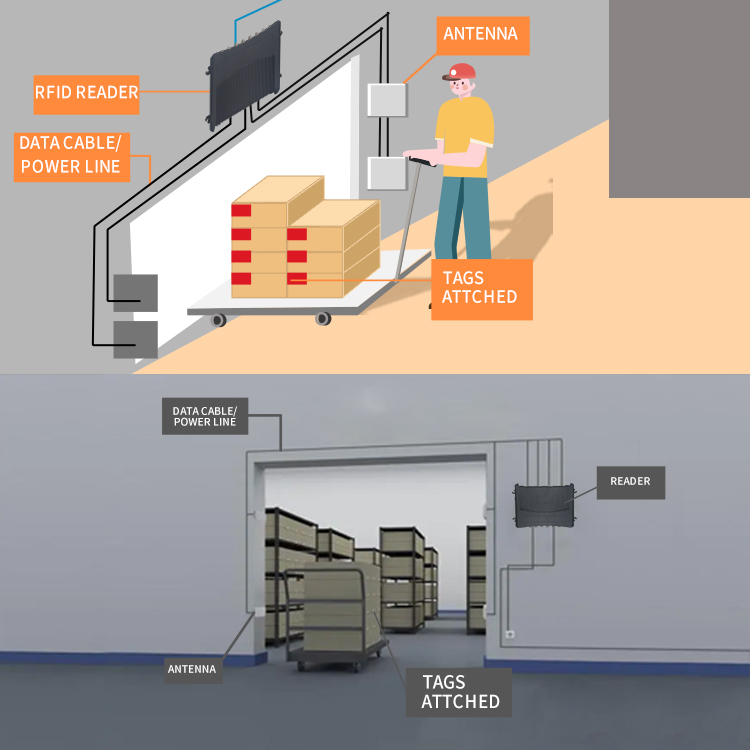
For example, an RFID doorway application needs to determine whether tags can be reliably detected as they pass through the intended reading zone.
A handheld inventory application may focus more on read coverage, operator movement, search time, and missed assets.
Step 2: Select Representative RFID Tags
Do not test only one tag sample.
Select several tag models that appear suitable for the application.
If possible, test multiple samples from each model to evaluate consistency.
Consider testing tags with differences in:
-
Size
-
Antenna design
-
Form factor
-
Mounting method
-
Operating frequency
-
Environmental protection
-
Adhesive
-
On-metal construction
-
Tag housing
For example, if you are tracking metal equipment, include RFID tags designed for metal surfaces.
If you are tracking plastic containers, test tags mounted directly on the actual container material.
The purpose is to compare realistic options before committing to a large quantity.
Step 3: Test RFID Tags on the Actual Assets
One of the most important rules of RFID testing is to test the tag on the asset or product it will actually identify.
Do not rely exclusively on testing a loose RFID tag on a laboratory table.
Test the tag on:
-
Actual products
-
Actual containers
-
Actual tools
-
Actual equipment
-
Actual packaging
-
Actual pallets
-
Actual racks
The asset material can significantly influence RFID performance.
For example:
Cardboard → Plastic → Glass → Metal → Liquid-containing product
Each material can create a different RFID operating environment.
Testing the complete tag-and-asset combination provides much more useful information than testing the tag alone.
Step 4: Test Tag Placement
The position of the RFID tag can affect performance.
Test several possible mounting locations before choosing the final position.
For example:
Position A → Position B → Position C → Compare results
Consider:
-
Flat versus curved surfaces
-
Near metal edges
-
Near liquids
-
Near other tags
-
Inside or outside containers
-
Different heights
-
Different sides of an asset
The best location is not necessarily the most convenient location for attaching the tag.
It needs to provide reliable RFID performance while remaining practical for normal operations.
Step 5: Test RFID Read Range
Read range testing determines how far an RFID reader can reliably detect the tag.
A basic test can place the tagged asset at different distances from the RFID antenna.
For example:
0.5 m → 1 m → 2 m → 3 m → 5 m
At each distance, record whether the tag is detected consistently.
However, maximum read range should not be the only measurement.
A tag that can technically be detected from a long distance may not be suitable if the application requires precise zone control.
For example, a doorway system may need to detect tags inside the doorway while avoiding tags located in an adjacent area.
Therefore, useful RFID testing should evaluate both:
Required reads + unwanted reads
Step 6: Measure Read Rate
Read rate is one of the most useful metrics for RFID testing.
A simple test can compare the number of expected tags with the number actually detected.
For example:
100 expected tags → 98 detected → 2 missed
The test should record missed reads rather than reporting only the successful detections.
Repeat the test several times to determine whether the result is consistent.
A single successful scan does not necessarily demonstrate reliable RFID performance.
Testing should include repeated runs under realistic conditions.
Step 7: Test RFID Tag Orientation
RFID tag orientation can influence read performance.
Test tags in the orientations they are likely to have during normal operations.
For example:
-
Horizontal
-
Vertical
-
Angled
-
Rotated
-
Facing toward the antenna
-
Facing away from the antenna
This is particularly important when assets can move in different orientations.
A warehouse carton may rotate during transportation. A tool may be placed at different angles. A reusable container may enter a reader zone from several directions.
The test should reproduce these conditions where possible.
Step 8: Test Multiple RFID Tags at Once
Many RFID applications involve multiple tagged objects rather than one tag at a time.
Test realistic tag populations.
For example:
-
5 tags
-
10 tags
-
25 tags
-
50 tags
-
100 tags
The exact quantity should reflect the actual deployment.
Test tags:
-
Close together
-
Stacked
-
Mixed with different products
-
In containers
-
On shelves
-
Moving through a reader zone
The purpose is to determine whether the system can reliably identify the expected population under realistic density.
Step 9: Test for Unwanted RFID Reads
More RFID reads are not always better.
A good RFID system should detect the assets that belong to the intended reading zone without incorrectly detecting assets outside that zone.
For example:
Zone A = should be detected
Zone B = should not be detected
If a reader detects tags from both zones, the system may create inaccurate inventory or movement records.
Therefore, testing should measure:
-
Expected reads
-
Missed reads
-
Unwanted reads
-
Duplicate events
This is especially important for RFID portals, warehouse doorways, conveyor systems, and other fixed reading locations.
Step 10: Test Real Operating Conditions
Laboratory conditions rarely represent the complete operating environment.
Test the RFID tags where they will actually be used.
Depending on the application, this may include:
-
Warehouse aisles
-
Loading docks
-
Manufacturing areas
-
Outdoor storage
-
Cold rooms
-
Freezers
-
Production lines
-
Tool rooms
-
Distribution centres
Also consider environmental factors such as:
-
Temperature
-
Moisture
-
Dust
-
Chemicals
-
Vibration
-
Impact
-
Cleaning
-
Outdoor exposure
A tag that works perfectly indoors may not be suitable for an outdoor industrial application.
Step 11: Test RFID Tag Durability
RFID tags used for long-term asset tracking may remain attached for months or years.
The tag therefore needs to survive the expected operating environment.
Depending on the application, test exposure to:
-
Water
-
Heat
-
Cold
-
Chemicals
-
Oil
-
Cleaning agents
-
Abrasion
-
Impact
-
UV exposure
-
Vibration
After environmental exposure, test the tag again.
For example:
Initial RFID test → Environmental exposure → Repeat RFID test
This helps determine whether the tag continues to perform after being exposed to realistic conditions.
Step 12: Test the Mounting Method
A technically good RFID tag can still fail if it does not remain attached to the asset.
Test the intended mounting method.
Common options include:
-
Adhesive
-
Screws
-
Rivets
-
Bolts
-
Cable ties
-
Embedded installation
For adhesive-mounted tags, evaluate whether the adhesive remains secure under the expected temperature, moisture, vibration, and handling conditions.
For mechanically mounted tags, check whether the attachment method affects the asset or creates operational problems.
The test should evaluate both:
RF performance + physical attachment
Step 13: Test the RFID Reader and Antenna Configuration
RFID tags should be tested using the reader and antenna configuration planned for deployment.
Changing the reader, antenna, power settings, or installation position can change system performance.
Record important configuration details during testing, including:
-
Reader model
-
Antenna type
-
Antenna position
-
Reader power
-
Tag model
-
Tag orientation
-
Reader software
-
Relevant system settings
This makes the results easier to reproduce later.
Step 14: Test the Complete RFID Workflow
RFID testing should not stop at tag detection.
The complete workflow should also be tested.
For example:
Tag detected → Reader sends data → RFID software processes event → Database updates → User sees result
A warehouse receiving workflow might look like:
Truck arrives → Tagged goods enter reading zone → RFID reader captures tags → System identifies shipment → Inventory is updated
Test every stage.
A tag may be detected correctly but still fail to produce the desired business result if the software does not process the event correctly.
Step 15: Test Network and System Failures
Large-scale RFID deployments depend on more than radio communication.
Where relevant, test what happens when:
-
Network connectivity is interrupted
-
Reader loses power
-
Software temporarily stops responding
-
A reader restarts
-
Data is delayed
-
Duplicate events occur
-
A tag is replaced
The system should have a defined process for recovering from these situations.
Testing these scenarios before deployment can prevent unexpected operational problems later.
Step 16: Create RFID Acceptance Criteria
Before completing the pilot, define what counts as a successful result.
For example, the project may establish requirements for:
-
Minimum read performance
-
Maximum missed reads
-
Maximum unwanted reads
-
Required read range
-
Maximum processing time
-
Tag attachment durability
-
User workflow time
-
Data integration accuracy
The criteria should be defined before reviewing the final results.
This prevents the team from changing the definition of success after seeing the test data.
A Simple RFID Tag Testing Matrix
A structured testing matrix can make the evaluation easier.
| Test | Condition | Result to Record |
| Read range | Different distances | Detection consistency |
| Orientation | Multiple angles | Missed reads |
| Material | Actual asset surfaces | Read performance |
| Density | Different tag quantities | Tags captured |
| Movement | Different speeds | Detection reliability |
| Environment | Temperature/moisture/etc. | Performance before/after |
| Mounting | Different attachment methods | Attachment and read performance |
| Zone control | Nearby tagged assets | Unwanted reads |
| Workflow | Real operating process | Task completion |
| Integration | Reader to software | Data accuracy |
This creates a repeatable framework for comparing RFID tag options.
Common RFID Testing Mistakes
Testing Only One Tag
One successful tag does not prove that an entire batch will perform consistently.
Testing Only the Tag
The tag needs to be tested on the actual asset or product.
Testing Only in a Laboratory
Real operating environments may contain metal, liquids, movement, interference, and other variables.
Focusing Only on Maximum Read Range
A longer read range is not always better. The system may also need precise reading zones.
Ignoring Unwanted Reads
False or out-of-zone reads can create incorrect inventory or movement records.
Skipping Workflow Testing
An RFID system can have good RF performance but still be inconvenient or inefficient for employees.
Deploying Without a Pilot
A limited pilot can reveal problems before the RFID system is expanded across a larger facility or asset population. Pilot testing is commonly used to validate technology choices, workflows, integration, and operational performance before broader rollout.
How Long Should RFID Testing Take?
There is no universal testing period for every RFID project.
The appropriate duration depends on:
-
Number of assets
-
Complexity of the workflow
-
Environmental conditions
-
Number of locations
-
Required reliability
-
Integration complexity
-
Frequency of asset movement
A simple application may require a short controlled evaluation, while a large warehouse or industrial deployment may benefit from a longer pilot that captures different operating conditions.
The important point is to test long enough to expose normal variations rather than stopping after the first successful demonstration.
What Should an RFID Pilot Report Include?
A useful RFID pilot report should document:
-
RFID tag models tested
-
Asset types
-
Tag mounting positions
-
Reader configuration
-
Antenna configuration
-
Test environment
-
Test dates
-
Number of test runs
-
Expected tag population
-
Detected tags
-
Missed tags
-
Unwanted reads
-
Workflow results
-
Environmental test results
-
Integration issues
-
User feedback
-
Final recommendation
This creates a clear record for deciding whether to proceed with the larger deployment.
When Is an RFID Tag Ready for Large-Scale Deployment?
An RFID tag is ready for broader deployment when the complete solution has demonstrated consistent performance against predefined requirements.
The decision should consider:
RFID tag performance + asset compatibility + environmental durability + reader performance + workflow + software integration
If one component performs poorly, simply increasing the number of readers or tags may not solve the underlying problem.
It may be necessary to change:
-
RFID tag type
-
Tag placement
-
Mounting method
-
Reader position
-
Antenna configuration
-
Software logic
-
Workflow
Frequently Asked Questions
What is the most important RFID tag test?
There is no single test that is most important for every application. A strong evaluation normally combines read performance, asset compatibility, environmental durability, unwanted-read testing, and workflow validation.
Should RFID tags be tested on the actual products?
Yes. Testing on the actual product or asset is important because materials, shape, packaging, and tag placement can affect RFID performance.
How do you test RFID read range?
Place the tagged asset at controlled distances from the RFID reader and measure whether the tag can be detected consistently at each distance. Repeat the test under realistic orientations and conditions.
How do you measure RFID read rate?
Use a known population of tags, record which tags are expected, run the RFID process, and compare the expected tags with the successfully detected tags. Missed and unwanted reads should be recorded separately.
Should RFID tags be tested in different orientations?
Yes. If assets can move or be stored in different orientations, test the tag in those positions to determine whether performance remains consistent.
Do you need to test multiple RFID tags at the same time?
Yes, when the real application involves multiple tagged objects. Testing several tags together can reveal performance issues that are not visible when testing a single tag.
Should RFID tags be tested for durability?
Yes, particularly for long-term asset tracking or harsh environments. Test the tag under the environmental conditions it is expected to encounter and evaluate RFID performance afterward.
Is a successful RFID demonstration enough for deployment?
No. A demonstration can show that the technology works, but a deployment decision should be based on repeatable testing under the actual asset, environment, reader configuration, and workflow conditions.
Testing RFID tags before large-scale deployment is an important step in choosing a reliable RFID solution. The objective is not simply to determine whether a reader can detect a tag. The more useful question is whether the tag, asset, reader, environment, software, and workflow can operate together consistently.
A practical evaluation should test read range, read rate, tag orientation, mounting position, multiple-tag scenarios, unwanted reads, environmental durability, and system integration.
The safest approach is to start with representative RFID tags and actual assets, define clear acceptance criteria, conduct a controlled pilot, record both successful and unsuccessful results, and only then move toward large-scale deployment.
This process can help identify unsuitable tag designs, installation problems, workflow issues, and integration gaps before they become expensive problems across the full RFID deployment.