



How Can RFID Tags Automate Warehouse Inventory Tracking?
Warehouse inventory tracking often involves repetitive tasks such as scanning products, counting stock, checking locations, and updating inventory records. As the number of items increases, manual tracking can become time-consuming and difficult to maintain consistently.
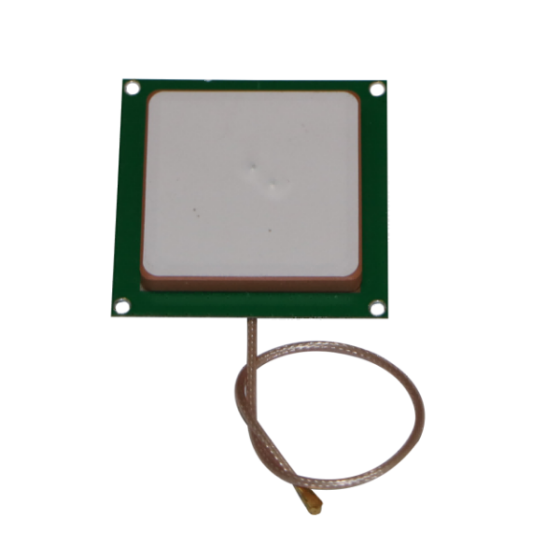
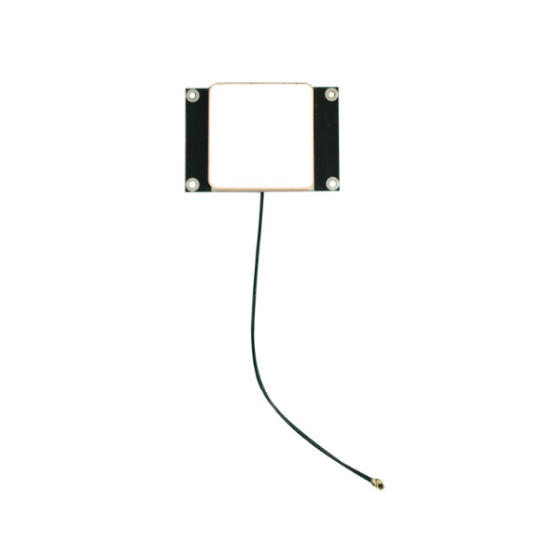
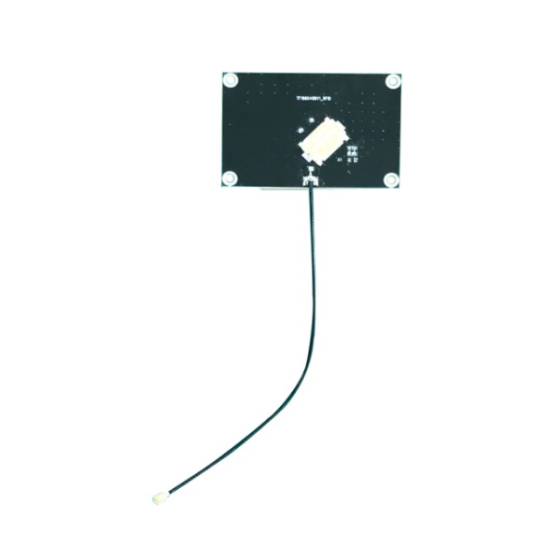
RFID tags can automate warehouse inventory tracking by giving products, cartons, pallets, and assets unique digital identities that RFID readers can detect without requiring individual barcode scans. When RFID readers are placed at key points throughout a warehouse, tagged inventory can be identified as it moves through receiving, storage, picking, packing, and shipping.
This allows businesses to automate more of the inventory tracking process, reduce manual data entry, improve inventory visibility, and identify discrepancies more efficiently.
What Is Automated Warehouse Inventory Tracking?
Automated warehouse inventory tracking means using technology to identify, record, and monitor inventory movement with limited manual intervention.
A traditional inventory tracking process may require employees to:
-
Scan a barcode.
-
Record the item.
-
Confirm its location.
-
Update the inventory system.
-
Repeat the process for the next item.
RFID can automate several of these steps.
A typical RFID inventory tracking workflow looks like this:
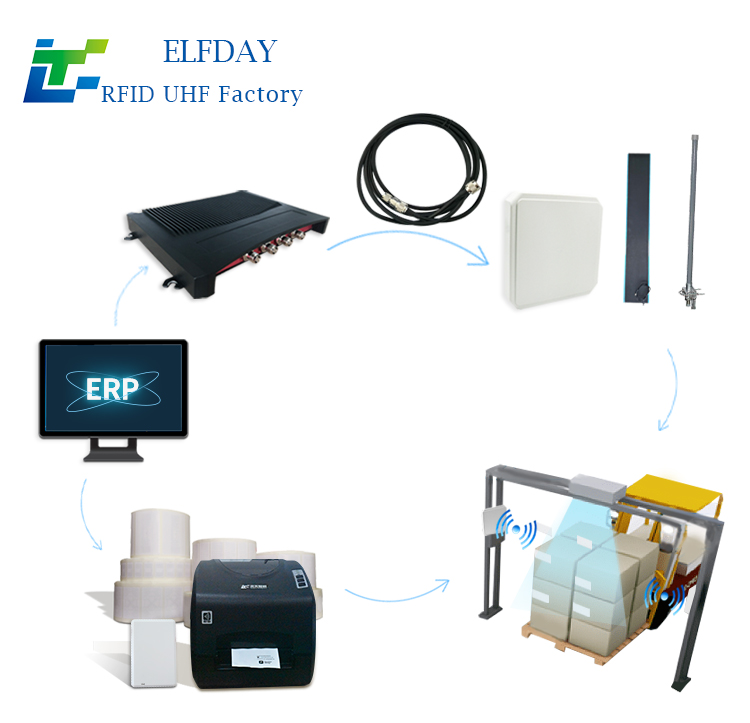
RFID tag → RFID reader → Item identification → Inventory event → Software update
When a tagged product passes through a configured RFID reading area, the reader can capture the tag's identifier and send the information to the connected inventory system.
The system can then associate that event with a specific inventory movement.
How Do RFID Tags Automate Warehouse Inventory Tracking?
RFID automation is based on several connected functions rather than the tag alone.
1. RFID Tags Give Inventory a Digital Identity
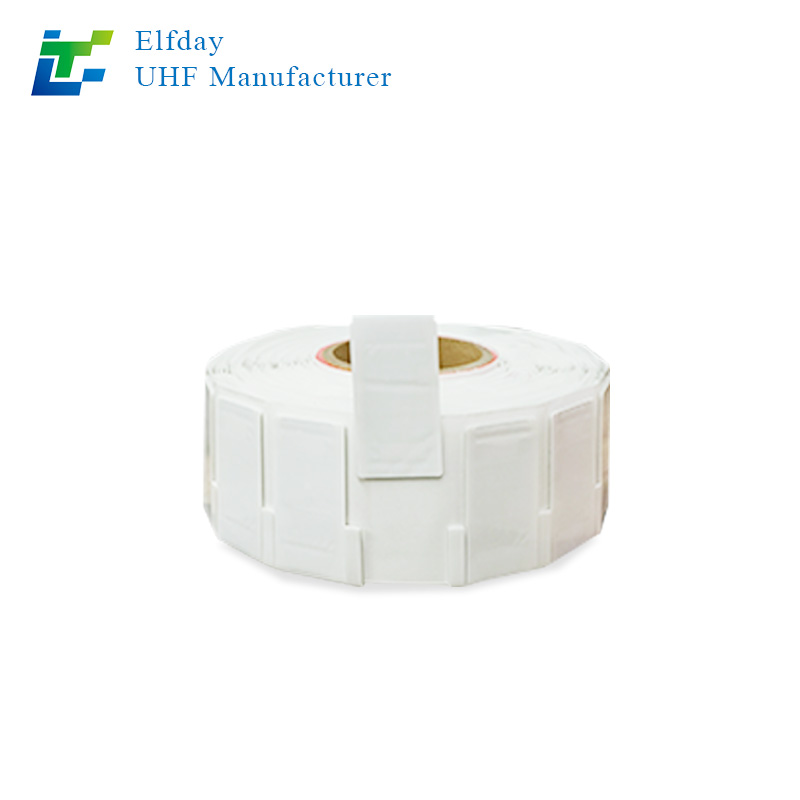
An RFID tag can be associated with a unique identifier for a product, carton, pallet, container, or asset.
For example, a warehouse may assign RFID tags at different tracking levels:
| Inventory Level | Example |
| Individual item | A finished product |
| Carton | A box containing multiple products |
| Pallet | A grouped shipment |
| Container | A reusable storage or transport container |
| Asset | Equipment or warehouse tools |
The RFID tag provides the identity that allows the physical object to be connected with information in the warehouse management system.
2. RFID Readers Automatically Detect Tagged Items
The next part of the automation process is RFID reading.
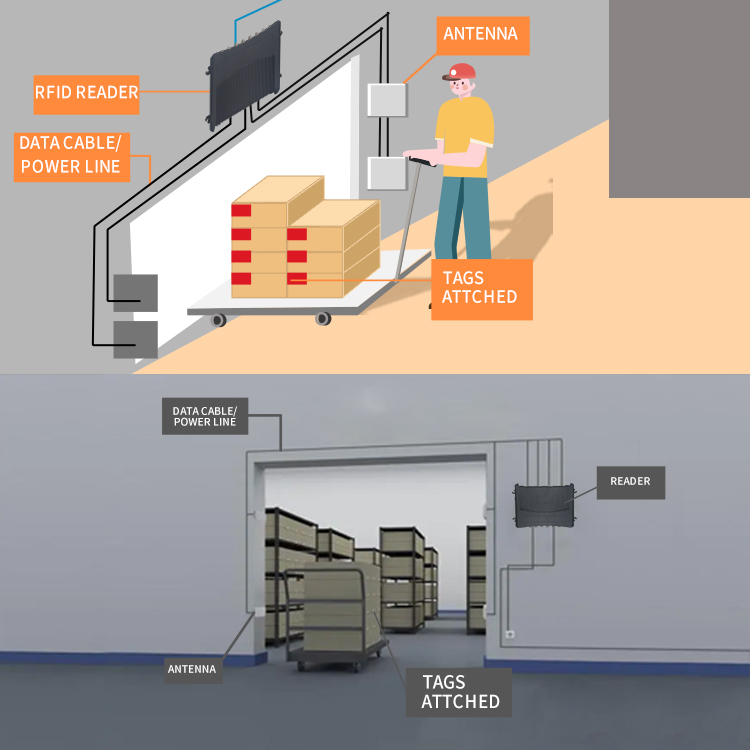
RFID readers can be installed at strategic warehouse locations, including:
-
Receiving docks
-
Warehouse entrances
-
Storage zones
-
Conveyor lines
-
Picking areas
-
Packing stations
-
Shipping docks
When tagged inventory enters a reader's operating area, the system can detect the tags and capture their identifiers.
This reduces the need for employees to manually scan each item.
3. Multiple Items Can Be Identified During One Reading Event
One of the most useful features of RFID for warehouse automation is the ability to identify multiple tags within a reading area.
For example, imagine a pallet carrying 40 tagged cartons.
With a traditional barcode workflow, employees may need to scan cartons individually or scan a pallet-level barcode.
With an appropriately designed RFID system, the pallet can pass through a reading zone while the system detects multiple carton tags.
This can make high-volume inventory tracking more efficient.
Actual read performance depends on tag design, tag placement, reader configuration, antenna positioning, product materials, tag orientation, and the surrounding environment.
4. RFID Can Automate Receiving
Warehouse receiving is a natural starting point for automated RFID inventory tracking.
When a shipment arrives, tagged products, cartons, or pallets can pass through an RFID reading area.
The workflow can be:
Shipment arrives → RFID tags detected → Items identified → Expected shipment compared → Inventory records updated → Goods moved to storage
The warehouse system can compare detected items with the expected shipment information.
If the shipment is expected to contain 100 tagged cartons but only 97 are detected, employees can investigate the discrepancy before the goods are put away.
This can reduce manual identification during receiving and provide earlier visibility into inventory discrepancies.
5. RFID Can Track Inventory During Put-Away
After receiving, inventory usually moves into designated storage locations.
RFID can help record this movement when readers are positioned at appropriate locations.
For example:
Receiving Area → Warehouse Zone A → Storage Area → Picking Location
When a tagged item is detected at a particular reading point, the inventory system can record the corresponding event.
This can help warehouse teams understand where inventory was last detected.
However, RFID does not automatically provide precise indoor positioning. The amount of location information available depends on reader coverage, system configuration, and the warehouse layout.
6. RFID Can Automate Inventory Movement Tracking
Warehouse inventory rarely stays in one place.
Products move between:
-
Receiving
-
Storage
-
Picking
-
Packing
-
Staging
-
Shipping
-
Returns
RFID readers can be placed at important transition points to automatically capture these movements.
This creates an event-based tracking process.
For example:
Item received → Item stored → Item picked → Item packed → Item shipped
Each detected RFID event can be associated with the item's inventory record.
This can provide a more consistent digital history of inventory movement than relying entirely on manual updates.
7. RFID Can Reduce Manual Cycle Counting
Cycle counting is an important warehouse activity, but manually counting inventory can consume significant labor.
Employees may need to walk through storage areas, locate products, count quantities, record results, and compare physical stock with system data.
RFID can help automate parts of this process.
A handheld RFID reader can be used to scan multiple tagged items within its reading range while an employee moves through the warehouse.
Fixed RFID readers can also support automated identification at selected locations.
The result can be a faster inventory checking process with less individual scanning.
8. RFID Helps Detect Inventory Discrepancies
Automated tracking can also help identify differences between expected and detected inventory.
Examples include:
-
Products recorded in the system but not physically detected
-
Products detected in an unexpected location
-
Incorrect quantities
-
Items that have not moved as expected
-
Products associated with the wrong shipment
-
Inventory that appears to have bypassed a process
RFID does not automatically determine the cause of a discrepancy.
Instead, it provides identification events that can help warehouse teams find potential problems earlier.
For example, if a product is expected to move from receiving to storage but the system does not detect the expected movement, employees can investigate the item before the issue affects order fulfillment.
RFID vs. Manual Warehouse Inventory Tracking
RFID changes how inventory identification is performed.
| Tracking Method | Manual Scanning | RFID |
| Item identification | Employee scans item | Reader detects tag |
| Multiple items | Usually scanned individually | Multiple tags can be detected |
| Line of sight | Usually required for barcode | Usually not required |
| Data entry | More manual steps | More automated |
| Inventory movement | Often manually recorded | Can be captured at reader points |
| Cycle counting | Labor intensive | Can be partially automated |
| Automation potential | Moderate | High |
| Environment sensitivity | Relatively straightforward | Requires tag and reader planning |
RFID does not necessarily replace barcodes in every warehouse.
Many operations can use both technologies depending on the workflow.
Where Should RFID Readers Be Installed?
Reader placement is one of the most important parts of an automated warehouse inventory tracking system.
Potential locations include:
Receiving Docks
Readers can identify incoming products, cartons, or pallets as shipments arrive.
Warehouse Entrances
Readers can record inventory entering or leaving specific areas.
Conveyor Systems
RFID can identify tagged items while they move through automated material-handling processes.
Picking Areas
Readers can help confirm the movement of inventory through picking workflows.
Packing Stations
RFID identification can be used to associate products with packing or order-processing events.
Shipping Docks
Readers can help verify that the expected tagged inventory has entered the shipping process.
The goal is not necessarily to install readers everywhere. Instead, reader coverage should focus on locations where inventory movement or identification matters most.
Can RFID Provide Real-Time Warehouse Inventory Tracking?
RFID can support real-time or near-real-time inventory tracking when the system is designed to capture RFID events continuously and transmit them to connected software.
However, RFID itself does not automatically guarantee real-time inventory tracking.
Several components influence how quickly inventory information is updated:
-
Reader coverage
-
Tag read performance
-
Network connectivity
-
Data processing
-
Warehouse management software
-
System integration
-
Reader configuration
A warehouse with limited reader coverage may still benefit from RFID, but its inventory data may not be continuously updated across every location.
What Types of Warehouse Inventory Can RFID Track?
RFID can be used at different inventory levels.
Individual Products
Useful when businesses need item-level inventory visibility.
Cartons and Cases
Useful for warehouses that manage products in boxes or cases.
Pallets
Pallet-level RFID tracking can simplify the identification of large groups of products.
Returnable Containers
RFID can help track reusable bins, totes, trays, and containers as they move through warehouse operations.
Warehouse Assets
Equipment and other valuable assets can also be assigned RFID tags for automated identification.
The appropriate tracking level depends on the business process and the information the warehouse needs to collect.
What Factors Affect RFID Warehouse Tracking Performance?
RFID automation depends on the complete system.
Tag Placement
A tag should be placed where it can communicate effectively with the RFID reader.
Tag Orientation
The position of the tag relative to the reader antenna can influence read performance.
Metal
Metal surfaces can interfere with conventional RFID tags. Specialized on-metal RFID tags may be required for metal equipment or products.
Liquids
Liquids can affect UHF RFID performance. Products containing liquids may require careful tag selection and placement.
Tag Density
Large numbers of tags in a small area can require careful reader configuration and testing.
Reader and Antenna Configuration
Reader power, antenna position, reading zones, and warehouse layout can all influence performance.
Software Integration
RFID data becomes much more useful when it is connected to warehouse management, inventory, or enterprise systems.
How to Automate Warehouse Inventory Tracking With RFID
A practical RFID implementation can follow these steps.
Step 1: Identify the Manual Tracking Problems
Start by identifying where employees spend the most time.
For example:
-
Manual barcode scanning
-
Cycle counting
-
Receiving verification
-
Inventory searches
-
Shipment verification
-
Stock reconciliation
Step 2: Define What Needs to Be Tracked
Decide whether the system should track individual products, cartons, pallets, containers, or assets.
Step 3: Select Suitable RFID Tags
Consider the product's:
-
Material
-
Size
-
Packaging
-
Metal content
-
Liquid content
-
Temperature exposure
-
Required read range
-
Attachment method
Step 4: Map the Warehouse Workflow
Identify the key points where inventory enters, leaves, or changes status.
For example:
Receiving → Put-Away → Storage → Picking → Packing → Shipping
Step 5: Install RFID Readers at Key Points
Reader placement should be based on the actual inventory workflow.
Step 6: Connect RFID Data With Warehouse Software
RFID events should be integrated into the system responsible for inventory records.
This allows the warehouse to turn tag detections into meaningful inventory events.
Step 7: Test With Real Inventory
Testing should use actual products, packaging, shelves, pallets, and warehouse conditions.
This helps identify issues that may not appear during basic equipment testing.
Step 8: Monitor and Improve
After deployment, monitor:
-
Missed reads
-
Unexpected reads
-
Inventory discrepancies
-
Reader coverage
-
Tag performance
-
Processing time
-
System integration
Continuous testing can help improve the reliability of the tracking process.
Benefits of Automated RFID Warehouse Inventory Tracking
When properly implemented, RFID can provide several operational benefits.
Less Manual Scanning
Employees can spend less time individually scanning products.
Faster Inventory Identification
Multiple tagged items can potentially be identified during the same reading event.
Better Inventory Accuracy
Automated identification can reduce some sources of manual recording errors.
Improved Inventory Visibility
More frequent RFID events can provide a clearer view of inventory movement.
Faster Receiving and Shipping
RFID can help automate identification at warehouse entry and exit points.
Easier Cycle Counting
Handheld or fixed RFID readers can reduce the effort required to identify large numbers of tagged items.
Better Exception Management
Potential discrepancies can be identified earlier for investigation.
Common Mistakes to Avoid
Choosing Tags Without Testing
A tag that performs well on one product may not work equally well on another.
Ignoring Metal and Liquids
Product materials can significantly affect UHF RFID performance.
Installing Readers Without Mapping the Workflow
Reader placement should correspond to important inventory events.
Expecting RFID to Track Everything Everywhere
RFID only detects tags within the system's effective reading environment.
Treating RFID Data as a Complete Inventory System
RFID provides identification events. The inventory software must interpret and use those events correctly.
Skipping Pilot Testing
A small pilot can reveal problems with tag placement, reader coverage, software integration, and warehouse processes before a full rollout.
Frequently Asked Questions
Can RFID automatically track warehouse inventory?
Yes. RFID can automate inventory identification and movement tracking by detecting tagged products with fixed or handheld RFID readers. The captured data can then be connected to inventory or warehouse management software.
Does RFID eliminate manual inventory counts?
Not necessarily. RFID can reduce manual counting and scanning, but physical verification may still be useful depending on the warehouse process and accuracy requirements.
Can RFID track multiple products at once?
Yes. RFID systems can be designed to detect multiple tags within the same reading area, which makes them suitable for bulk inventory identification.
Can RFID track inventory location?
RFID can provide location-related information when readers are strategically installed at warehouse locations. However, standard RFID does not inherently provide precise continuous positioning.
Is RFID suitable for pallet tracking?
Yes. RFID tags can be attached to pallets, allowing pallets to be identified as they move through receiving, storage, staging, and shipping areas.
Can RFID replace barcodes in a warehouse?
RFID can replace some barcode-based workflows, but it does not have to replace barcodes completely. Many warehouses use both technologies for different processes.
How accurate is RFID inventory tracking?
Accuracy depends on tag selection, placement, reader coverage, antenna configuration, product materials, software integration, and warehouse conditions. Real-world testing is important before large-scale deployment.
RFID tags can automate warehouse inventory tracking by connecting physical inventory with digital identification and automatically capturing inventory events at important points in the warehouse.
Instead of relying entirely on employees to scan products individually, RFID readers can detect multiple tagged items as they move through receiving, storage, picking, packing, and shipping.
This can reduce manual scanning, speed up inventory identification, support cycle counting, improve inventory visibility, and help warehouse teams identify discrepancies sooner.
The effectiveness of an RFID warehouse inventory tracking system depends on more than the RFID tags themselves. Tag selection, placement, reader coverage, antenna configuration, product materials, warehouse layout, and software integration all need to work together.
For this reason, the most practical approach is to start with a specific warehouse tracking problem, test RFID with real inventory, and then expand the system based on actual operational results.