



Can RFID Tags Be Read Without Line of Sight? What You Need to Know
Yes, RFID tags can generally be read without line of sight. Unlike barcodes, which usually require a scanner to see the printed code, RFID technology uses radio-frequency signals to communicate between a reader and a tag. This means the tag does not normally need to be directly visible to the reader.
This capability makes RFID useful for inventory management, warehouse operations, logistics, manufacturing, retail, and asset tracking.
However, RFID does not mean a tag can always be read through any material or from any position. The RFID frequency, tag design, distance, orientation, surrounding materials, and reader configuration all affect performance.
Why Does RFID Not Need Line of Sight?
The biggest difference between RFID and barcode technology is the way information is communicated.
A barcode scanner uses light to read a printed pattern:
Scanner → light → barcode → reflected light → scanner
The barcode therefore needs to be visible to the scanner.
RFID uses radio-frequency communication:
Reader → RF signal → RFID tag → tag response → reader
Because radio waves do not depend on visual visibility in the same way as optical scanning, an RFID reader can often communicate with a tag that is hidden from direct view.
How Does a Reader Read a Hidden RFID Tag?
The basic process is relatively simple.
1. The Reader Sends a Radio Signal
The RFID reader transmits a radio-frequency signal through its antenna.
2. The Tag Receives the Signal
The RFID tag's antenna receives the signal.
For a passive RFID tag, the incoming RF energy can provide the power needed to activate the RFID chip.
3. The Chip Processes the Signal
The RFID chip processes the reader's communication and determines how to respond.
4. The Tag Sends Data Back
The tag communicates its identification or other available information back to the reader.
Passive UHF RFID tags commonly use backscatter communication to accomplish this.
5. The Reader Decodes the Response
The reader receives the tag's response and converts it into usable digital information.
The process can be summarized as:
RF signal → tag activation → chip processing → tag response → reader → software
At no point does the reader need to visually “see” the tag in the way a barcode scanner does.
Can RFID Tags Be Read Inside Boxes?
Yes, RFID tags can often be read inside boxes or other suitable packaging.
This is one of the most useful applications of non-line-of-sight RFID.
For example, a warehouse may place RFID-tagged products inside a cardboard carton.
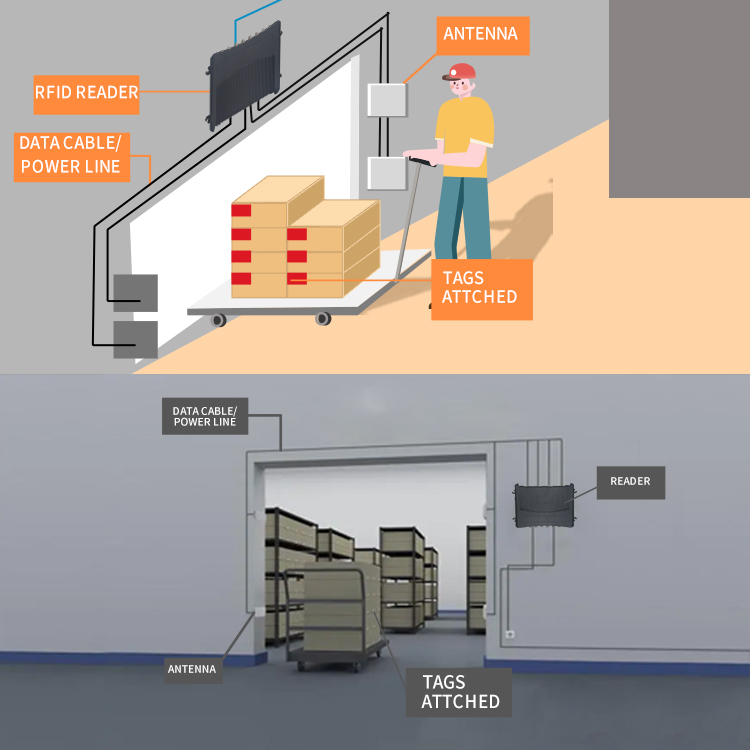
Instead of opening the box and scanning each product individually, an RFID reader may be able to detect the tags while the carton remains closed.
This can support:
-
Receiving
-
Inventory counting
-
Shipping
-
Carton tracking
-
Pallet management
-
Warehouse automation
The actual reading performance depends on the products and materials inside the box.
Can RFID Read Through Cardboard?
Cardboard is generally compatible with many RFID applications.
A standard RFID label attached to a cardboard carton can often be detected without direct visual contact.
This is one reason RFID is commonly considered for supply-chain and warehouse applications.
For example:
RFID-tagged carton → closed carton → RFID reader → tag detected
The employee does not necessarily need to open the carton or locate the tag visually.
Can RFID Read Through Plastic?
RFID can often communicate through many types of plastic.
Plastic packaging is used in numerous RFID applications, including product identification and inventory tracking.
However, not every plastic product behaves identically. The thickness, composition, shape, and contents of the package can affect the RF environment.
A plastic container holding a dry product may present very different conditions from a plastic container filled with liquid.
Can RFID Read Through Metal?
Standard RFID tags can have significant problems when placed directly on metal.
Metal can affect the electromagnetic behavior of the RFID antenna and interfere with the communication between the reader and tag.
This does not mean RFID cannot be used on metal.
Instead, applications involving metal often use on-metal RFID tags specifically designed for conductive surfaces.
Common examples include:
-
Industrial machinery
-
Metal tools
-
Steel containers
-
Vehicles
-
Equipment
-
Metal storage racks
-
Manufacturing components
The tag design helps maintain more suitable RF performance when mounted on or near metal.
Can RFID Read Through Liquids?
Liquids can also affect RFID communication.
Water and other liquids can absorb or interact with radio-frequency energy, which can reduce the effectiveness of some RFID tags.
This can create challenges when tags are placed directly on:
-
Bottled beverages
-
Water containers
-
Liquid chemicals
-
Cosmetics
-
Moist food products
-
Other high-moisture products
In these applications, tag selection and placement are especially important.
Does RFID Work Through Walls?
Sometimes, but it should not be assumed that RFID can reliably read through every wall.
The result depends on:
-
Wall construction
-
Material density
-
RFID frequency
-
Reader power
-
Tag type
-
Distance
-
Antenna configuration
-
Tag orientation
A thin, non-conductive barrier may have relatively little effect in some applications, while reinforced concrete, metal structures, or other dense materials can create much greater challenges.
Therefore, RFID should be described as non-line-of-sight technology, not as technology that can read through unlimited physical barriers.
What Materials Affect RFID Reading?
Different materials interact with radio-frequency signals in different ways.
| Material | Typical RFID Consideration |
|---|---|
| Cardboard | Often suitable for RFID |
| Paper | Generally suitable |
| Plastic | Often suitable, depending on application |
| Glass | Often suitable |
| Wood | Usually manageable |
| Metal | Can significantly affect standard RFID tags |
| Water/liquid | Can absorb or alter RF energy |
| Concrete | Performance depends on construction and thickness |
These are general considerations rather than guarantees.
The exact RFID performance should always be tested using the actual tag, product, reader, and environment.
Does Tag Orientation Matter Without Line of Sight?
Yes.
No line of sight does not mean orientation is irrelevant.
RFID tags use antennas with specific electromagnetic characteristics.
If the tag is positioned in an unfavorable orientation relative to the reader antenna, the communication can become weaker.
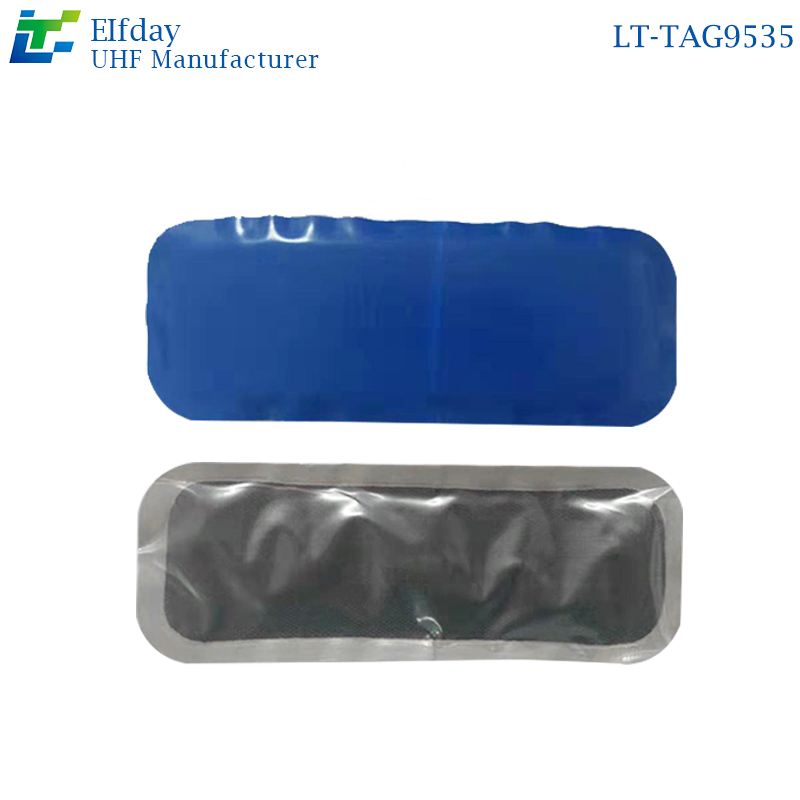
For example, a tag may perform differently when:
-
Facing the reader
-
Rotated 90 degrees
-
Mounted vertically
-
Mounted horizontally
-
Positioned close to metal
-
Surrounded by other tagged products
This is why tag placement is an important part of RFID system design.
How Far Can RFID Read Without Line of Sight?
There is no universal answer.
RFID reading distance depends on the specific technology and environment.
Factors include:
-
RFID frequency
-
Reader output power
-
Reader antenna
-
Tag antenna
-
Tag sensitivity
-
Tag orientation
-
Environmental materials
-
Interference
-
Installation design
UHF RFID is commonly used when longer read distances and multi-tag identification are required.
HF and LF RFID are generally associated with shorter-range applications.
The important point is:
RFID can operate without line of sight, but it still has a practical communication range.
Can RFID Read Multiple Tags Without Line of Sight?
Yes.
Many RFID systems can identify multiple tags within a reader's operating zone.
Imagine a warehouse carton containing several RFID-tagged products.
A reader can send an RF signal toward the carton, and multiple tags can respond.
The system may then identify:
-
Product A
-
Product B
-
Product C
-
Product D
-
Product E
without requiring each product to be individually visible.
RFID communication protocols use anti-collision mechanisms to help manage multiple tags responding within the same reading area.
Why Is Non-Line-of-Sight Reading Useful?
The ability to read tags without direct visibility can simplify many operational processes.
Faster Inventory Checks
Employees do not need to locate and visually scan every tag.
Easier Warehouse Receiving
Tagged cartons or pallets can potentially be identified as they move through designated reading areas.
Automated Tracking
Readers can detect tagged items as they pass through specific locations.
Better Asset Visibility
Equipment and tools can be identified even when tags are mounted in less visible positions.
Reduced Manual Scanning
RFID can reduce the need for employees to physically position every item in front of a scanner.
RFID vs. Barcode: Line-of-Sight Differences
| Feature | RFID | Barcode |
| Direct line of sight | Usually not required | Usually required |
| Communication | Radio frequency | Optical |
| Hidden tag reading | Often possible | Generally not |
| Multiple items | Often possible | Usually scanned individually |
| Reading direction | More flexible | Requires suitable positioning |
| Rewritable data | Possible with some tags | No |
| Automation potential | High | Moderate |
The non-line-of-sight capability is one of RFID's major practical advantages.
However, barcodes remain useful where low cost, simplicity, and direct visual scanning are appropriate.
Can RFID Read Tags Inside a Pallet?
Yes, RFID can be used to identify tags associated with palletized goods without requiring each tag to be visually exposed.
A typical workflow might look like:
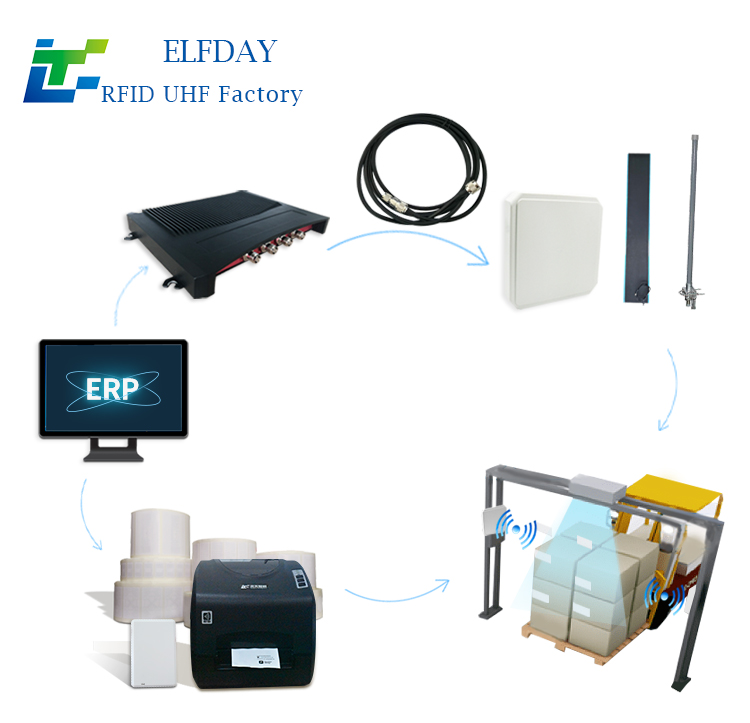
Pallet arrives → RFID reader creates a read zone → tags respond → reader captures IDs → software processes the data
This can support warehouse receiving, shipping verification, and inventory tracking.
However, densely packed products can create challenging RF conditions.
For example, a pallet containing many metal objects or liquid-filled products may require specialized tag selection and careful placement.
Can RFID Read Tags Inside a Bag?
In many cases, yes.
RFID tags can potentially be read through bags made from suitable materials.
For example, RFID can be used with:
-
Clothing bags
-
Plastic packaging
-
Retail packaging
-
Component bags
-
Small parts packaging
The material itself is only one factor. The contents of the bag can have an even greater effect on RFID performance.
Can RFID Read a Tag Behind Another Tag?
Potentially.
RFID systems are designed to handle environments containing multiple tags, and anti-collision protocols allow readers to identify tags individually.
However, physical arrangement can still influence performance.
If tags are tightly packed, poorly oriented, or surrounded by challenging materials, some tags may be harder to read.
Good tag placement and reader configuration help improve reliability.
What Can Cause an RFID Tag to Be Missed?
Even without a line-of-sight requirement, a tag can fail to respond for several reasons.
The Tag Is Too Far Away
The RF energy reaching the tag may be insufficient.
The Tag Is Poorly Oriented
The tag antenna may not interact effectively with the reader's field.
The Tag Is Mounted on Metal
A standard tag may not perform properly when attached directly to metal.
The Tag Is Near Liquid
Liquid can affect RF performance.
The Reader Antenna Is Poorly Positioned
An unsuitable antenna position can create gaps in the read zone.
The Environment Has RF Interference
Other radio-frequency sources or equipment can affect communication.
The Wrong Tag Is Being Used
Different materials and applications require different RFID tag designs.
How Can RFID Reading Performance Be Improved?
If an RFID application needs reliable non-line-of-sight reading, several factors should be considered.
Choose the Correct RFID Tag
Select a tag designed for the target surface and environment.
Test Tag Placement
Try different mounting positions and orientations.
Select Appropriate Reader Antennas
The antenna should match the required reading area and application.
Control the Read Zone
A clearly defined reading area can help reduce missed or unwanted reads.
Consider the Surrounding Materials
Metal, liquids, dense products, and other objects should be evaluated during system testing.
Test Real Products
Laboratory specifications do not always represent real-world performance.
Testing with the actual products, packaging, tags, and equipment is one of the best ways to evaluate an RFID installation.
Frequently Asked Questions
Can RFID tags be read without line of sight?
Yes. RFID readers communicate with tags using radio-frequency signals, so direct visual contact is generally unnecessary.
Can RFID read a hidden tag?
Yes, provided the tag is within a suitable RF communication area and the surrounding materials do not prevent reliable communication.
Can RFID read through cardboard boxes?
Yes. RFID tags can often be read through cardboard packaging, making the technology useful for warehouse and logistics applications.
Can RFID read through metal?
Standard RFID tags may have difficulty when mounted directly on metal. Specialized on-metal RFID tags are available for metal surfaces.
Can RFID read through water?
Water and other liquids can affect RFID performance. Specialized tags and appropriate placement may be required for liquid-heavy applications.
Can RFID read multiple tags at once?
Many RFID systems can identify multiple tags in the same reading zone. Anti-collision protocols help manage communication between multiple tags.
Does RFID have to see the tag?
No. RFID generally does not require the visual line of sight needed by barcode scanners.
Is RFID completely unaffected by obstacles?
No. RFID does not require line of sight, but physical materials, distance, orientation, interference, and tag design can all affect reading performance.
RFID tags can generally be read without line of sight because RFID uses radio-frequency communication rather than optical scanning. This allows tags to be detected inside suitable packaging, among other tagged items, or in locations where direct visual access would be inconvenient.
The key advantage is flexibility: the reader does not need to visually see the tag to communicate with it.
At the same time, non-line-of-sight RFID has practical limitations. Metal, liquids, tag orientation, distance, reader antennas, RF interference, and tag design can all affect whether a tag is detected reliably.
For this reason, successful RFID deployment depends not only on the reader and tag, but also on choosing the right tag for the material, positioning it correctly, and testing the complete system in its actual operating environment.